
What's Happening?
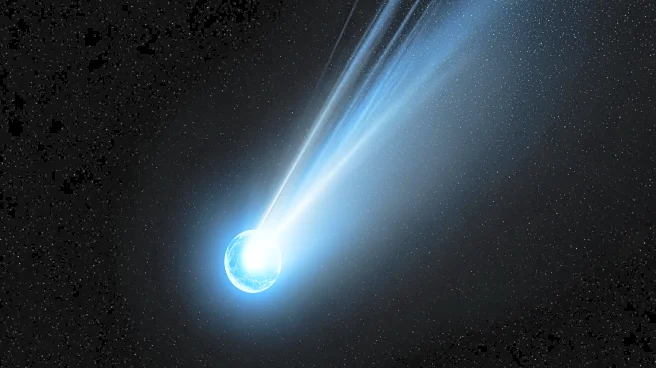
On December 12, 2025, the European Space Agency's XMM-Newton observatory released an X-ray image of the interstellar comet 3I/ATLAS, marking a significant observation as the comet approaches its closest
point to Earth on December 19. The X-ray view, alongside new images from the Gemini North telescope showing a green glow, highlights the comet's evolving behavior as it moves away from the Sun. The green hue is attributed to gas emissions, particularly diatomic carbon, a common phenomenon in active comets. The X-ray observations are crucial as they can detect gases like molecular hydrogen and nitrogen, which are challenging to measure with optical instruments. This data is vital for understanding the composition of interstellar objects, especially in light of past debates about the unusual ices in the first interstellar visitor, 1I/‘Oumuamua.
Why It's Important?
The observation of 3I/ATLAS in X-ray light is significant for several reasons. It provides a unique opportunity to study the composition of interstellar comets, which can offer insights into the materials present in other star systems. The ability to detect gases like hydrogen and nitrogen through X-ray observations can help scientists test hypotheses about the presence of exotic ices in interstellar objects. This is particularly important as 3I/ATLAS is only the third confirmed interstellar object observed in our solar system. Understanding its composition and behavior can enhance our knowledge of the building blocks of other planetary systems and the processes that govern their formation.
What's Next?
As 3I/ATLAS approaches its closest point to Earth, scientists will continue to monitor its behavior using a variety of observatories, including the Hubble Space Telescope and other ground-based facilities. The data collected will be crucial for understanding the comet's composition and activity. After its closest approach, 3I/ATLAS will continue its journey out of the solar system, passing Jupiter's orbit in spring 2026. The ongoing observations aim to extract as much scientific information as possible before the comet becomes too distant to study effectively.