


What's Happening?
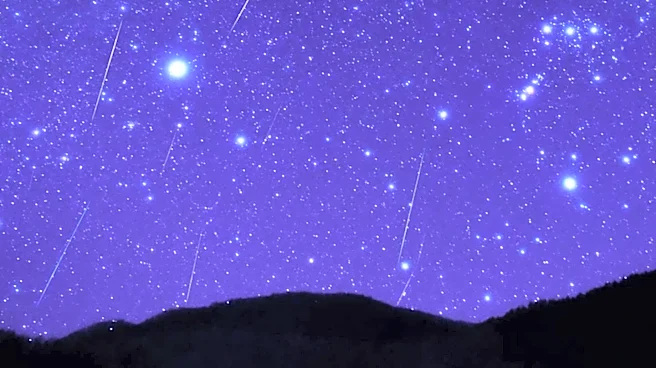
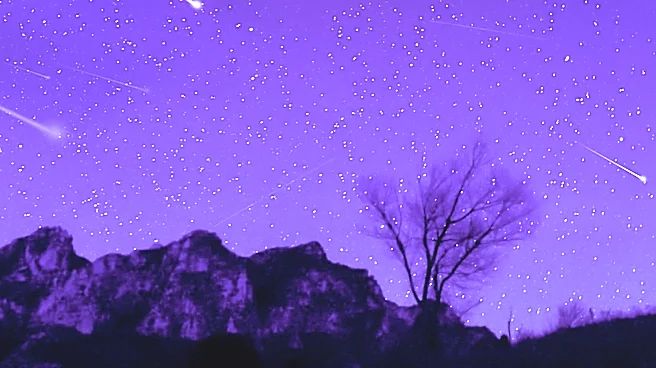
The Leonid meteor shower is set to peak on November 18, 2026, providing stargazers with an opportunity to observe fast-moving meteors. This annual event is caused by debris from Comet 55P/Tempel-Tuttle. Observers can expect to see approximately a half-dozen
or more Leonid meteors per hour, with some streaking across the sky at speeds of about 44 miles (70 kilometers) per second, making them among the fastest meteors experienced throughout the year. The best viewing times are in the early morning hours, after the Moon has set and the shower's radiant point, located within the constellation Leo, rises high in the sky before dawn. To maximize visibility, it is recommended to look about 40 to 60 degrees away from the constellation Leo, as this area is where meteors with the longest trails are most likely to appear. The sky on November 18 will also feature a conjunction of Jupiter and Mars in Leo, and Venus will be visible near Spica in Virgo.
Why It's Important?
The annual Leonid meteor shower offers a significant astronomical event for both amateur astronomers and the general public across the U.S. It provides a unique opportunity to witness celestial mechanics in action, as Earth passes through the debris trail of Comet 55P/Tempel-Tuttle. The high speed of Leonid meteors makes them particularly striking, contributing to public engagement in science and astronomy. Such events can inspire interest in STEM fields, especially among younger generations, and foster a greater appreciation for the natural world beyond Earth. For educational institutions and science communicators, the meteor shower serves as a practical, accessible subject for teaching about comets, planetary orbits, and atmospheric phenomena. Furthermore, the visibility of other celestial bodies like Jupiter, Mars, and Venus during the same period enhances the overall stargazing experience, making it a rich observational night.
What's Next?
Following the peak on November 18, the Leonid meteor shower will gradually diminish in activity. While the peak offers the highest concentration of meteors, some activity may still be observable in the nights immediately following, though at reduced rates. Stargazers interested in future meteor showers can look forward to other annual events, such as the Geminids in December, which are known for their prolific displays. For those who missed the Leonids, upcoming astronomical events will continue to provide opportunities for sky observation. Astronomy enthusiasts can consult meteor shower calendars and local astronomical society schedules for information on future celestial phenomena, including other meteor showers, planetary conjunctions, and lunar events. Continued clear skies and minimal light pollution will remain crucial factors for optimal viewing of these natural spectacles.
Beyond the Headlines
Beyond the immediate visual spectacle, the Leonid meteor shower holds deeper scientific and historical significance. Historically, the Leonids have been responsible for some of the most spectacular meteor storms on record, particularly in years when Earth passes through denser parts of Comet Tempel-Tuttle's debris trail, which occurs roughly every 33 years. These intense displays have profoundly impacted human culture, inspiring awe, fear, and scientific inquiry throughout history. From a scientific perspective, studying meteor showers like the Leonids provides valuable data on the composition and distribution of cometary debris, offering insights into the early solar system and the processes of planetary formation. The observation of these meteors also contributes to understanding atmospheric entry phenomena and can aid in the development of spacecraft protection against micrometeoroid impacts. The transient nature of these events underscores the dynamic and ever-changing environment of our solar system.