





What's Happening?
Civil engineering researchers have developed an innovative concrete mix that not only enhances structural integrity but also actively absorbs carbon dioxide from the atmosphere. This new material, detailed in a study published in the journal Carbon Research,
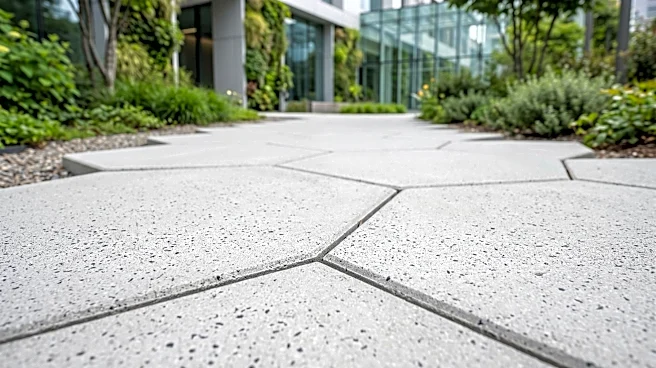
incorporates zeolite and bamboo biochar. The optimized mix, which replaces 50% of fine sand with zeolite and 1% of cement with bamboo biochar, shows a nearly 8% increase in compressive strength and a 15% boost in split tensile strength compared to standard concrete. Each piece of this eco-friendly concrete can capture up to 1.2 grams of carbon dioxide daily, with CO2 penetrating 15 millimeters into the material over one week. This development offers a promising solution for reducing atmospheric carbon levels, particularly in urban environments with high emissions. The research highlights the potential for infrastructure projects to serve as passive carbon sinks throughout their operational life.
Why It's Important?
The development of this carbon-absorbing concrete is significant for the U.S. construction industry and environmental policy. Cement production is a major contributor to global greenhouse gas emissions, and this innovation provides a viable alternative that can mitigate these impacts. By integrating natural mineral absorbers and organic waste byproducts, the new concrete offers a dual benefit: improved structural performance and active environmental remediation. This could lead to a shift in construction practices, promoting the use of sustainable materials in road pavements, sewer pipelines, parapet walls, and commercial structures. The ability of infrastructure to act as a carbon sink could help states and municipalities meet climate goals and reduce their carbon footprint. Furthermore, the enhanced durability of the material could lead to longer-lasting infrastructure, reducing maintenance costs and the need for frequent replacements, thereby contributing to economic sustainability.
What's Next?
The next steps for this eco-friendly concrete involve further testing and scaling up production for broader application. Researchers will likely focus on long-term performance assessments in various environmental conditions to ensure its durability and carbon absorption capabilities over extended periods. Collaboration between research institutions, material manufacturers, and construction companies will be crucial for integrating this material into mainstream construction projects. Policy makers may consider incentives or regulations to encourage the adoption of such sustainable building materials, potentially through green building codes or infrastructure funding programs. The successful implementation of this technology could pave the way for a new era of carbon-negative construction, transforming urban landscapes into active participants in climate change mitigation efforts. Additionally, further research into optimizing the proportions of zeolite and biochar, as well as exploring other sustainable additives, could lead to even more effective and cost-efficient solutions.
Beyond the Headlines
Beyond its immediate environmental and structural benefits, this innovation has deeper implications for resource management and the circular economy. The use of bamboo biochar, an organic waste byproduct, exemplifies how waste materials can be repurposed into valuable resources, reducing landfill burden and promoting resource efficiency. Zeolites, as natural mineral absorbers, also highlight the potential of naturally occurring materials in addressing complex environmental challenges. This approach aligns with the principles of a circular economy, where resources are kept in use for as long as possible, extracting maximum value and recovering materials at the end of their service life. The concept of 'passive carbon sinks' embedded within urban infrastructure could fundamentally change how cities approach sustainability, moving beyond simply reducing emissions to actively removing carbon from the atmosphere. This could also spur innovation in other industries to develop similar dual-purpose materials that address both functional needs and environmental concerns.