





What's Happening?
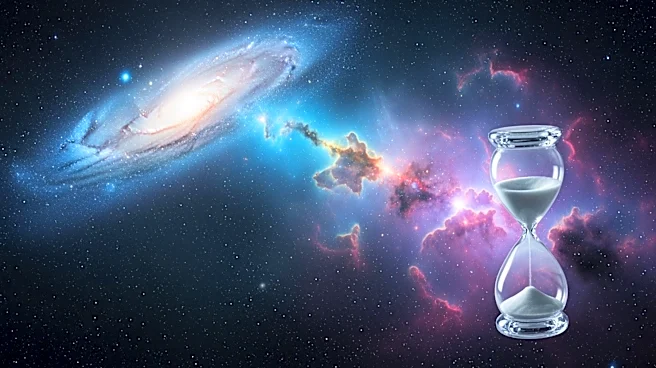
A new study by researchers at Radboud University suggests that the universe will end much sooner than previously estimated. The study, published in the Journal of Cosmology and Astroparticle Physics, revises the timeline for the universe's end from 10^1100
years to 10^78 years. This dramatic revision is based on the theory of Hawking radiation, which posits that black holes slowly leak particles and eventually evaporate. The researchers argue that this process affects all objects with a gravitational field, not just black holes, leading to the eventual evaporation of celestial bodies like white dwarf stars.
Why It's Important?
This study challenges long-held scientific beliefs about the universe's lifespan, prompting a reevaluation of cosmological theories. The implications of a shorter timeline for the universe's end could influence future research in astrophysics and cosmology. Understanding the mechanisms behind Hawking radiation and its effects on celestial bodies is crucial for advancing knowledge of the universe's fundamental processes. While the revised timeline still spans an incomprehensibly long period, it underscores the dynamic nature of scientific inquiry and the potential for new discoveries to reshape our understanding of the cosmos.