


What's Happening?
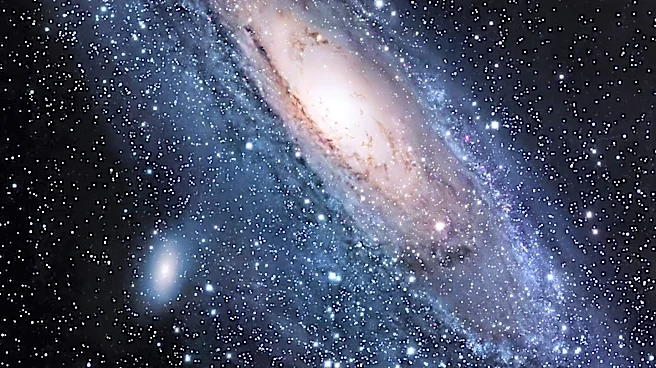
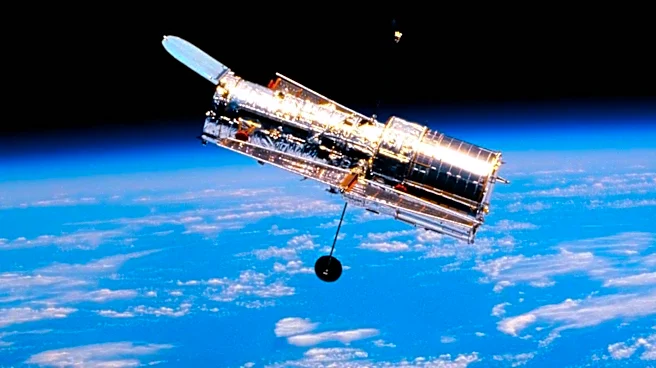
NASA's Hubble Space Telescope has provided new insights into the Andromeda galaxy, revealing a significant decline in star formation over the past 500 million years. The study, published in The Astrophysical Journal, utilized data from two Hubble surveys
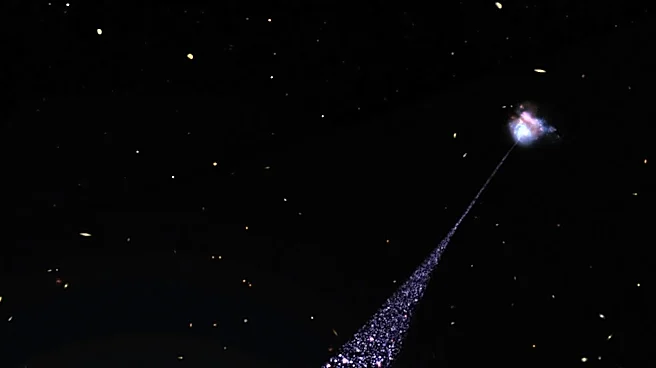
to map two-thirds of Andromeda's disk in detail, measuring about 200 million individual stars. The findings indicate that Andromeda, a spiral galaxy similar in size to the Milky Way and located approximately 2.5 million light-years from Earth, has experienced a steep drop in star formation, particularly in the last 40 million years. The research team, led by astronomers from the University of Washington, discovered that the rate of star formation has decreased from about one solar mass per year 500 million years ago to about one-fifth of a solar mass per year currently. The decline is primarily observed in a star-forming ring located 32,000 light-years from the galaxy's center.
Why It's Important?
The decline in star formation in the Andromeda galaxy provides valuable insights into the life cycle of galaxies and their evolutionary processes. Understanding these patterns helps astronomers predict the future behavior of galaxies, including our own Milky Way. The study's findings suggest that the decline is not due to a lack of material for star formation but rather a natural winding down from a previously more active state. This research enhances our comprehension of galactic dynamics and the factors influencing star formation rates. Additionally, the study highlights the potential interactions between Andromeda and its satellite galaxy, M32, which may have contributed to the observed decline. Such interactions are crucial for understanding the complex gravitational relationships between galaxies and their impact on star formation.
What's Next?
The research team plans to continue analyzing Hubble data and combine it with observations from ground-based telescopes to further investigate Andromeda's history. Future studies will focus on the potential interactions between Andromeda and M32, aiming to determine the timing and impact of these interactions on star formation. Additionally, NASA's upcoming Nancy Grace Roman Space Telescope, set to launch as early as August 30, will provide a broader perspective by imaging the entirety of Andromeda's disk and surrounding halo. This will enable astronomers to measure hundreds of millions of stars, offering new opportunities for groundbreaking research on galactic evolution.