



What's Happening?
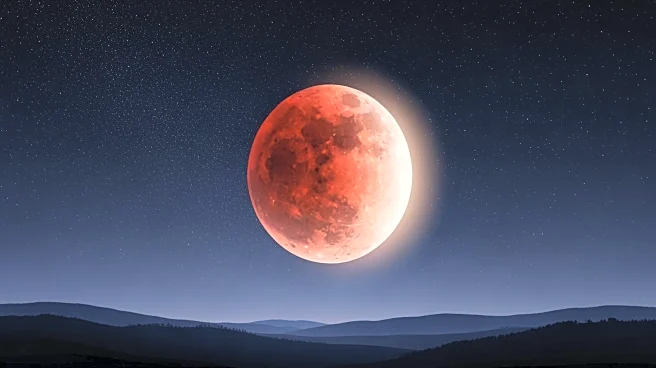
NASA has announced that a total lunar eclipse will occur on March 3, 2026, and will be visible across the United States. This astronomical event, often referred to as a 'blood moon,' occurs when the Earth passes between the sun and the moon, casting a shadow
that gives the moon a reddish-orange hue. The eclipse will be visible in the early morning hours, beginning around 4 a.m. EST and ending around 7 a.m. EST, with a partial eclipse continuing until approximately 9 a.m. EST. The event will also be visible in parts of eastern Asia, Australia, and throughout the Pacific, while being partially visible in central Asia and much of South America. However, it will not be visible in Africa or Europe.
Why It's Important?
The total lunar eclipse presents a unique opportunity for millions of people across the United States to witness a rare celestial event without the need for special equipment. Such events can spark public interest in astronomy and science, encouraging educational activities and community gatherings. The visibility of the eclipse across a wide geographical area enhances its accessibility, allowing people from various regions to experience the phenomenon. Additionally, the event may boost tourism in areas known for clear night skies, as enthusiasts travel to optimal viewing locations.
What's Next?
Following the lunar eclipse, sky watchers can look forward to another celestial event on March 8, when Venus and Saturn will appear closer to each other in the sky. This conjunction will provide another opportunity for astronomical observation. For those interested in learning more about the eclipse and other upcoming celestial events, NASA's 'What's Up' guide offers detailed information and viewing tips.