



What's Happening?
Florida Atlantic University (FAU) has been awarded a $3 million grant from the U.S. Department of Labor’s Strengthening Institutions Program. This funding will support the development of a quantum-ready workforce in Florida through education and research
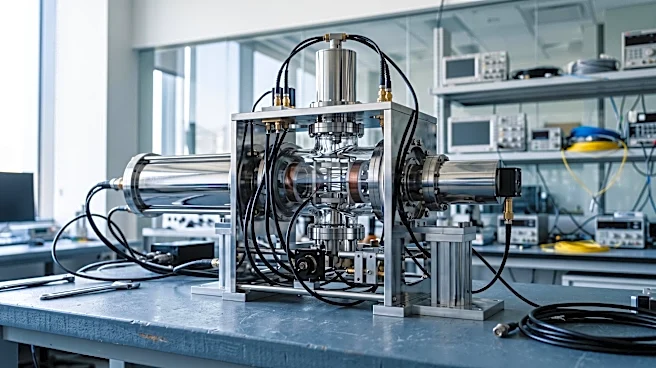
training in quantum-enabled sensing and communications. The project, titled 'Building Florida’s Quantum-Ready Workforce: Quantum-Skilled Pathways in Integrated Sensing and Communications from Early College to Graduate Studies,' is led by Dr. George Sklivanitis and Dr. Dimitris Pados from FAU’s Center for Connected Autonomy and Artificial Intelligence (CA-AI). The initiative will establish educational pathways from early college through graduate studies, combining foundational quantum education with advanced coursework and hands-on research. FAU plans to acquire Rydberg-atom quantum radio-frequency (RF) sensing and communications equipment paired with an optical atomic clock, making it the first university in the nation to house this technology, in collaboration with Infleqtion Inc.'s Colorado Quantum Innovation Center.
Why It's Important?
This grant is crucial for addressing the growing demand for a skilled workforce in the rapidly evolving field of quantum technologies. As quantum sensing, communications, and computing advance, there is a significant need for professionals with specialized knowledge and practical experience. By establishing comprehensive educational pathways, FAU will prepare students to contribute to this cutting-edge sector, strengthening Florida's position in the quantum economy. The acquisition of advanced quantum equipment, such as the Rydberg-atom quantum RF sensing and communications system and an optical atomic clock, will provide students with unparalleled hands-on experience, bridging the gap between theoretical concepts and real-world engineering applications. This investment not only benefits students but also supports the broader U.S. effort to maintain leadership in quantum science and technology, which has implications for national security, economic competitiveness, and scientific innovation.
What's Next?
Over the five-year grant period, the program is expected to reach more than 100 students. CA-AI researchers will develop and deliver a new course in quantum sensing and communications, providing direct experience with the new equipment and its applications. The initiative aims to connect quantum education directly to the engineering skills students will need as these technologies transition from research environments to practical applications. FAU is also expanding its quantum capabilities by preparing to host a D-Wave Advantage2™ quantum computer, further solidifying its role as Florida's first quantum university. This comprehensive approach will involve continuous collaboration with industry partners like Infleqtion Inc. to ensure the curriculum remains relevant and responsive to industry needs, ultimately preparing a highly skilled talent pool for the quantum workforce.
Beyond the Headlines
The investment in quantum workforce development at FAU signifies a strategic national effort to cultivate expertise in a field poised to revolutionize various industries. Beyond the immediate educational benefits, this initiative could foster a vibrant ecosystem of quantum innovation in Florida, attracting research and development investments and creating new high-tech jobs. The emphasis on hands-on experience with cutting-edge equipment is vital for translating theoretical knowledge into practical applications, which is often a bottleneck in emerging technologies. This program also highlights the increasing importance of interdisciplinary collaboration, combining engineering, computer science, and physics to tackle complex quantum challenges. The long-term implications include enhanced capabilities in secure communications, advanced sensing for defense and environmental monitoring, and breakthroughs in materials science and drug discovery, all driven by a well-prepared quantum workforce.