






What's Happening?
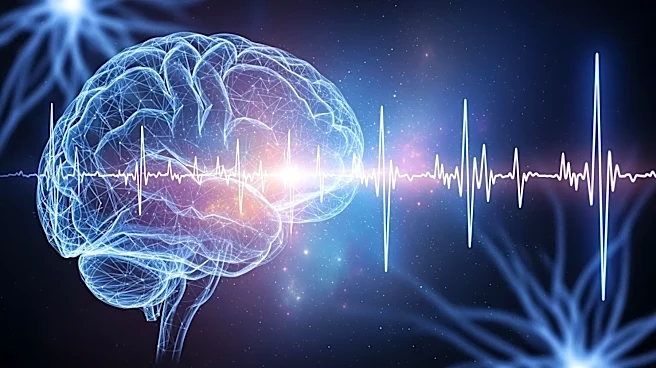
Researchers from MIT and Northeastern University have proposed a new model of brain function that challenges traditional views on categorization. According to a review article by cognitive scientists Lisa Feldman Barrett and Earl K. Miller, the brain does
not passively observe and then categorize sensory inputs. Instead, it actively predicts and prepares motor responses before fully perceiving stimuli. This model suggests that categorization is a predictive process embedded in the brain's architecture, allowing it to efficiently meet the body's needs in a fast-paced world. The researchers argue that the brain's architecture compresses sensory details into abstract categories, focusing on functionally equivalent information for survival. This predictive approach is supported by anatomical evidence showing that the majority of synapses in the visual cortex are feedback-oriented, carrying memories and goals rather than new sensory data.
Why It's Important?
This new model of brain function has significant implications for understanding human cognition and mental health. By redefining categorization as a predictive process, it challenges long-held beliefs about how the brain processes information. This perspective could lead to new approaches in treating mental health disorders. For instance, depression might be seen as a disorder of overly broad categorization, while autism could involve inadequate compression of sensory signals. The model also highlights the brain's efficiency in preparing for action, which could influence future research in cognitive science and neuropsychiatry. Understanding the brain's predictive nature could lead to advancements in artificial intelligence and machine learning, as these fields often draw inspiration from human cognitive processes.
What's Next?
Future research may focus on further exploring the implications of this predictive model of brain function. Scientists could investigate how this model applies to various cognitive and neuropsychiatric disorders, potentially leading to new diagnostic and therapeutic strategies. Additionally, this research could influence the development of AI systems that mimic human predictive capabilities. As the scientific community continues to explore the brain's predictive nature, collaborations across disciplines such as neuroscience, psychology, and computer science may emerge, fostering innovative approaches to understanding and enhancing human cognition.
Beyond the Headlines
The proposed model of brain function also raises ethical and philosophical questions about human perception and decision-making. If the brain is primarily predictive, this could challenge notions of free will and conscious decision-making, as actions may be pre-determined by neural predictions. Furthermore, this model could influence cultural and educational practices by emphasizing the importance of preparing for future scenarios rather than reacting to present stimuli. As society grapples with these implications, discussions about the nature of human experience and the role of technology in shaping our perceptions may become increasingly relevant.