
What's Happening?
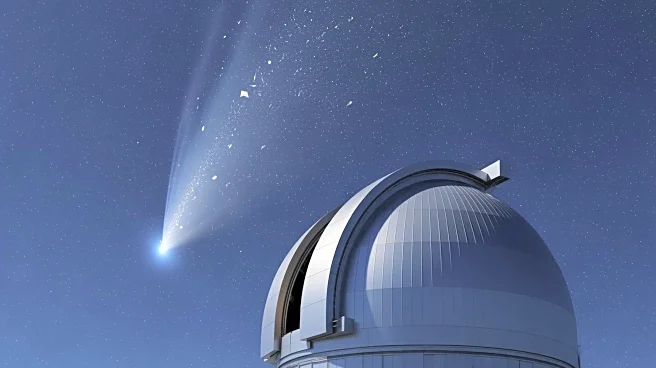
The interstellar comet 3I/ATLAS recently made its closest approach to Earth, passing at a distance of 168 million miles, which is nearly twice the distance from Earth to the Sun. This event marks the comet's
closest point to our planet as it continues its journey through the solar system. The comet, which is only the third interstellar object ever detected in our solar system, was first spotted by the Asteroid Terrestrial-Impact Last Alert System (ATLAS) in early July. As it passed close to Mars and then behind the Sun, it released various gases and elements, including cyanide, CO2, nickel, and iron, due to the Sun's heat. The comet is expected to visit other planets like Jupiter, Saturn, Uranus, and Neptune before leaving the solar system around 2028.
Why It's Important?
The passage of 3I/ATLAS is significant for several reasons. As an interstellar object, it provides a rare opportunity for scientists to study materials and elements that originated outside our solar system, offering insights into the composition and history of the universe. The detection and tracking of such objects are crucial for understanding potential threats to Earth, as ATLAS is designed to identify celestial bodies that could collide with our planet. The successful observation of 3I/ATLAS underscores the importance of maintaining and enhancing our astronomical observation capabilities, especially as satellite constellations increase and potentially obscure our view of the sky.
What's Next?
As 3I/ATLAS continues its journey, scientists will likely focus on analyzing the data collected during its approach to gain further insights into its composition and origin. The comet's trajectory through the solar system will be monitored to study its interactions with other planetary bodies. Additionally, the event highlights the need for continued investment in space observation technologies to ensure that future interstellar visitors are detected and studied effectively. The potential for increased satellite interference with astronomical observations may prompt discussions on how to mitigate such challenges.