
What's Happening?
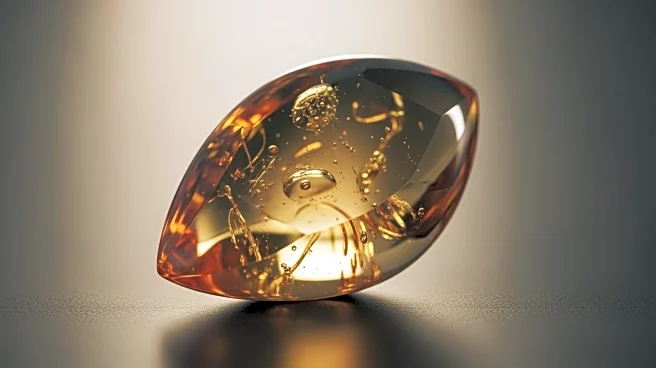
Researchers at Friedrich Schiller University Jena have conducted an in-depth analysis of a 40-million-year-old ant fossil found in Johann Wolfgang von Goethe's amber collection. The fossil, belonging to
the extinct species Ctenobethylus goepperti, was examined using advanced imaging techniques, including synchrotron micro-computed tomography. This allowed scientists to create detailed 3D reconstructions of the ant, providing new morphological data and insights into its evolutionary relationships. The study, published in Scientific Reports, highlights the ant's likely arboreal nesting behavior, drawing parallels with the modern ant genus Liometopum, which inhabits North America and warmer European regions.
Why It's Important?
The discovery and analysis of the ant fossil in Goethe's amber collection underscore the enduring value of historical scientific collections. By utilizing modern technology, researchers can extract new information from ancient specimens, contributing to our understanding of evolutionary biology and the history of life on Earth. This study not only enriches the field of paleontology but also demonstrates the potential of combining historical artifacts with contemporary scientific methods. The findings could influence future research on extinct species and their ecological roles, offering a deeper understanding of biodiversity and evolutionary processes.
What's Next?
The 3D model of the ant is now available online, allowing researchers worldwide to access and compare it with other fossils. This accessibility could lead to further discoveries and collaborations in the field of paleontology. Additionally, the study may inspire similar investigations into other historical collections, potentially uncovering more about extinct species and their environments. As technology continues to advance, the integration of historical and modern scientific approaches is likely to yield even more significant insights into the natural world.
Beyond the Headlines
The study highlights the intersection of art, history, and science, as Goethe's collection, originally valued for its aesthetic and optical properties, now serves as a crucial scientific resource. This reflects a broader trend of re-evaluating historical artifacts through a scientific lens, revealing their potential to contribute to contemporary research. The findings also emphasize the importance of preserving and studying historical collections, which can offer unique insights into past ecosystems and inform current conservation efforts.