



What's Happening?
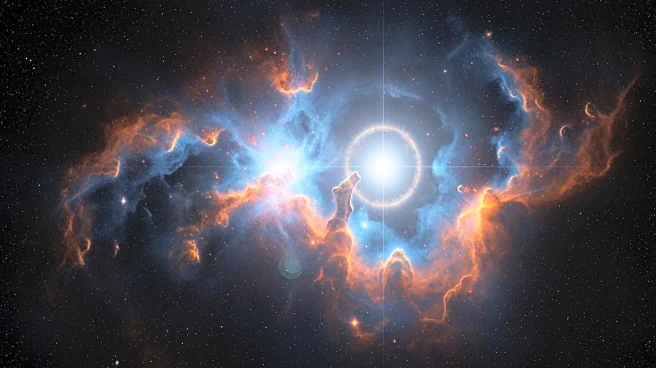
NASA's James Webb Space Telescope (JWST) has captured a detailed image of the Helix Nebula, also known as the Eye of Sauron, located in the constellation Aquarius. The nebula, approximately 650 light-years from Earth, is composed of material expelled
by a dying star, forming complex molecules that could seed future planets. The JWST's observations highlight structures called Cometary knots, each as large as the solar system, formed by the radiation of the central star. Additionally, the telescope has provided new insights into the protostar EC 53, revealing the formation of crystalline silicates in the hot, inner part of its surrounding gas and dust disk. These findings help explain the presence of crystalline silicates in comets at the edge of our solar system.
Why It's Important?
The discoveries made by the JWST are significant for understanding the lifecycle of stars and the formation of planetary systems. By studying the Helix Nebula, scientists gain insights into the processes that occur when stars die and how their remnants contribute to the creation of new celestial bodies. The findings related to the protostar EC 53 offer valuable information on the early stages of star formation and the distribution of materials that could eventually form planets and comets. These observations enhance our knowledge of the universe's evolution and the potential for life-supporting environments beyond Earth.
What's Next?
The ongoing observations by the JWST will continue to provide critical data on various celestial phenomena, aiding in the exploration of the universe's origins and the potential for life elsewhere. Future missions, such as NASA's Artemis II, scheduled for February 6, aim to further human exploration of space. This mission will send astronauts on a 10-day journey around the Moon, testing systems and hardware for future lunar landings. As these missions progress, they will contribute to our understanding of space and the potential for human habitation beyond Earth.