







What's Happening?
The Mundaneum, conceived by Belgian lawyers Paul Otlet and Henri La Fontaine in the early 20th century, aimed to collect, classify, centralize, and make universally available all human knowledge. This ambitious project, often referred to as an early 'internet,'
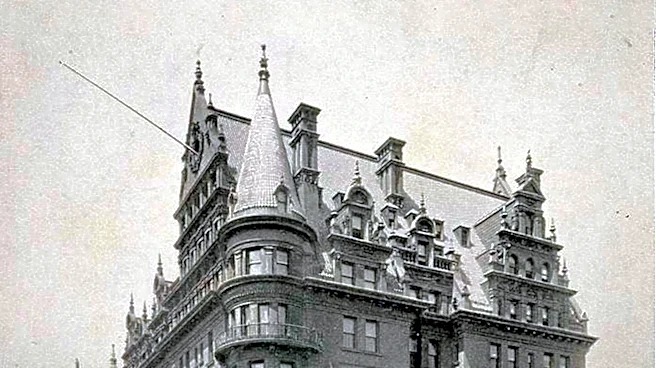
took the form of a vast paper archive, utilizing millions of index cards to record bibliographic details of books, articles, and documents. Otlet adapted the Dewey Decimal System for this purpose, creating a comprehensive catalog housed in rows of drawers. Initially located in Brussels' Cinquantenaire Palace, the Mundaneum was intended to have its own dedicated building designed by Le Corbusier, though this was never realized. The project faced significant setbacks, including its dismantling for a Third Reich art exhibition after the Nazi invasion in 1940.
Why It's Important?
The Mundaneum's vision is remarkably prescient, anticipating many features of the modern internet and information age. Otlet's later concepts included a global 'réseau' or network of 'electric telescopes' linked by telephone and television, where users could query a central archive and receive displayed answers on personal screens, even envisioning data sharing and social interactions among users. This early conceptualization of a global information network highlights the enduring human desire for universal access to knowledge and the potential of technology to facilitate it. The project demonstrates how foundational ideas about information organization and retrieval were being developed long before the digital era, influencing subsequent advancements in library science, information technology, and the very architecture of the internet.
What's Next?
While the physical manifestation of Otlet and La Fontaine's grand vision was largely dismantled, its conceptual legacy continues to be explored and celebrated. The Mundaneum now exists as a museum in Mons, Belgium, preserving the historical context and intellectual ambition of its founders. Visitors can explore the remaining archives and learn about the project's influence on information science. Additionally, an online catalog allows for virtual access to some of its collections, embodying Otlet's original desire for universal accessibility. The ongoing study of the Mundaneum serves as a reminder of the long history of efforts to organize and disseminate knowledge, offering valuable insights into the evolution of information systems and the philosophical underpinnings of our digital world.
Beyond the Headlines
The Mundaneum's story delves into the philosophical and ethical dimensions of universal knowledge access. Otlet and La Fontaine's ambition to centralize all human knowledge raises questions about control, bias, and the potential for information to be used for both benevolent and malevolent purposes. The project's fate during World War II, when it was repurposed by the Nazi regime, serves as a stark reminder of the vulnerability of information systems to political forces. Furthermore, the Mundaneum's emphasis on classification and indexing highlights the intellectual labor involved in making information discoverable and usable, a challenge that persists in the age of big data. It underscores that technology alone is not sufficient; robust organizational principles and ethical considerations are paramount in building effective and equitable knowledge systems.