






What's Happening?
A rare form of methanol, where all four hydrogen atoms are replaced by deuterium (heavy hydrogen), has been detected near the protostar IRAS4A2 in the constellation Perseus. This fully deuterated methanol is significantly more abundant in this region
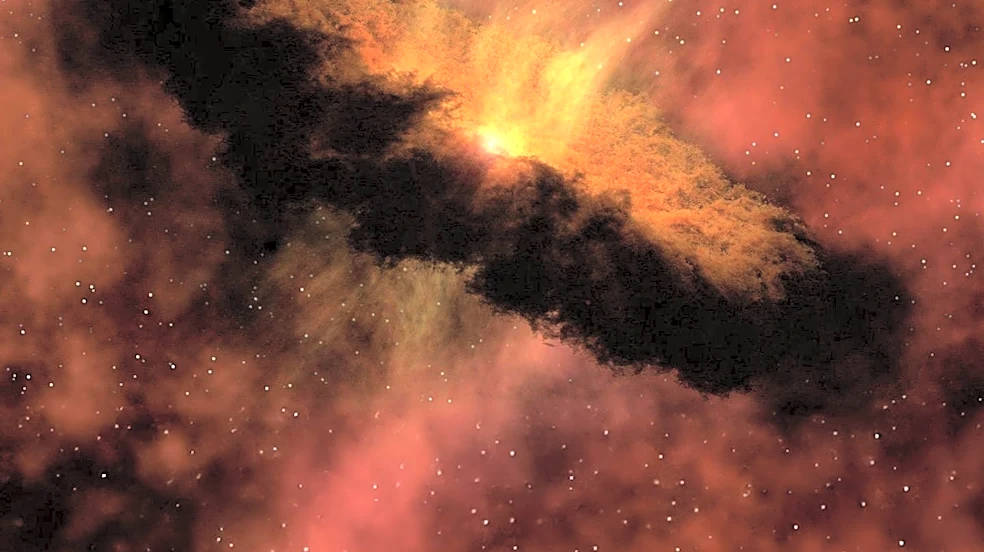
than current chemical models predict, suggesting a missing process in our understanding of how organic substances form before stars and planets emerge. While partially deuterated methanol has been observed before, this is the first detection of methanol with all four hydrogen atoms replaced by deuterium in interstellar space. Deuterium is scarce in the galaxy, with only one deuterium atom for every 60,000 ordinary hydrogen atoms. However, near IRAS4A2, one in every 2,500 methanol molecules is fully deuterated. The protostar IRAS4A2 is part of a binary system in the NGC 1333 molecular cloud, approximately 950 light-years from Earth, and was observed using the Atacama Large Millimeter/submillimeter Array (ALMA).
Why It's Important?
This discovery is crucial for astrochemistry and our understanding of the origins of organic molecules in space. Methanol is a fundamental organic compound, and its formation in cold clouds of gas and dust is a key step in the chemical evolution leading to more complex molecules, which are the building blocks of life. The unexpected abundance of fully deuterated methanol near IRAS4A2 indicates a significant gap in current chemical models. These models fail to account for the observed proportions, particularly for molecules with multiple deuterium atoms. Understanding this missing process is vital for accurately tracing the journey of complex molecules from interstellar clouds to nascent planets. It could reveal new pathways for the synthesis of organic matter in the early universe, potentially influencing our understanding of how life-enabling chemistry arises in planetary systems.
What's Next?
Researchers will focus on identifying the missing chemical process that leads to the overabundance of fully deuterated methanol. This will involve refining existing chemical models and potentially proposing new reaction pathways that can explain the observed deuterium enrichment. The detection of unidentified lines in the spectrum of IRAS4A2, which may correspond to other forms of methanol with two or three deuterium atoms, suggests that further laboratory data on these molecules will be critical for their identification. As more laboratory data become available, astronomers expect to easily identify these molecules, providing more pieces to the puzzle. Continued observations with powerful telescopes like ALMA, targeting other protostars and molecular clouds, will help determine if this phenomenon is widespread or unique to IRAS4A2, further informing our understanding of organic chemistry in star-forming regions.
Beyond the Headlines
The detection of fully deuterated methanol in such high concentrations has profound implications for the field of astrobiology. Deuterium enrichment is often used as a tracer for the conditions under which molecules form, particularly in cold environments. The discrepancy between observations and models suggests that the chemical factories of the universe might be more efficient or operate under different conditions than previously thought in producing complex organic molecules. This could mean that the precursors to life might be more readily available in protoplanetary disks than current theories suggest. The involvement of researchers from Kharkiv, Ukraine, in measuring the spectrum of fully deuterated methanol highlights the international collaborative nature of cutting-edge astronomical research, where specialized expertise from around the globe contributes to unraveling cosmic mysteries. This discovery pushes the boundaries of our knowledge about the chemical origins of life itself.