







What's Happening?
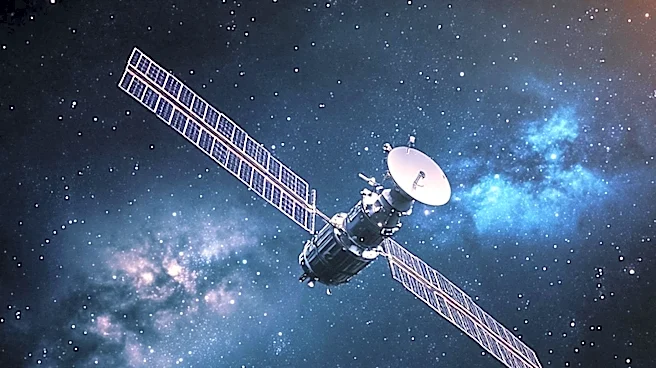
NASA's Voyager 1 spacecraft, launched in 1977, is currently operating with only two functional science instruments: a magnetometer and a plasma wave subsystem. The spacecraft, along with its twin Voyager 2, was originally equipped with ten identical instrument sets
for planetary flybys. Over the years, both have gradually lost functionality due to power constraints. Recently, NASA's Jet Propulsion Laboratory conducted a power test on Voyager 1 to implement a fix that had previously extended Voyager 2's operational life by another year. This fix, known as the 'Big Bang,' involves turning off several aging devices simultaneously and replacing them with lower-power alternatives. The goal is to conserve power and keep the remaining instruments operational. Voyager 1's power reserves are more limited than Voyager 2's, making this fix crucial for its continued operation.
Why It's Important?
The continued operation of Voyager 1 is significant for scientific research, as it provides valuable data from the outer reaches of the solar system. The spacecraft's ability to function despite its age demonstrates the durability and ingenuity of NASA's engineering. The success of the power-saving fix could extend Voyager 1's mission, allowing it to continue transmitting data that contributes to our understanding of interstellar space. This has implications for future space exploration missions, as it highlights the importance of developing long-lasting and adaptable technology. Additionally, the mission's success could inspire further investment in space exploration and technology development.
What's Next?
NASA plans to conduct a thermal test on Voyager 1 by the end of August to ensure the spacecraft's temperature remains within safe limits after the power swap. If successful, the fix will be fully implemented, potentially allowing the Low-energy Charged Particles experiment to be reactivated. This would mark a rare reversal in the mission's trend of deactivating instruments. Voyager 1 is also expected to reach a distance of one light-day from Earth by mid-November, which will further challenge communication and control efforts. The mission's progress will be closely monitored, as each step requires careful planning and execution due to the spacecraft's distance and limited power.