







What's Happening?
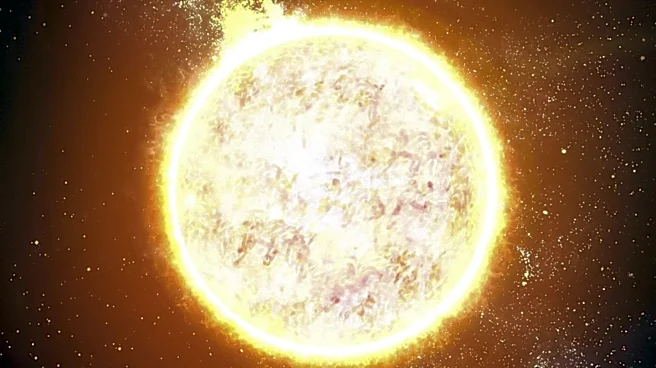
Chinese astronomers, utilizing the FAST radio telescope, have discovered a rare three-body star system located approximately 7,000 light-years from Earth. This system consists of two dead stars—a rapidly spinning pulsar and a white dwarf—and a 'living'
sun-like star. The pulsar, which spins over 300 times per second, orbits the white dwarf every eight days, while the sun-like star circles this pair every 73.5 years. This discovery, reported by a team led by Han Jinlin from the National Astronomical Observatories in Beijing, marks only the second such system known, with the first being found by a U.S.-led team in 2014 where all three stars were already dead. The system's unique configuration allows for the study of complex triple-star evolution and provides a rare opportunity to test Einstein's theory of gravity, specifically the strong equivalence principle.
Why It's Important?
This discovery is highly significant for astrophysics as it offers a unique laboratory for studying the intricate evolution of triple-star systems, which are generally poorly understood. The presence of a millisecond pulsar, an extremely rare component in such systems, makes it particularly valuable. Pulsars are incredibly precise cosmic clocks, and the observed slowing of this pulsar's spin, initially puzzling, was eventually attributed to the gravitational tug of the sun-like companion. This system provides an unprecedented opportunity to test fundamental physics, such as Einstein's strong equivalence principle, which posits that all objects fall at the same rate regardless of their mass or composition. Such tests using extreme gravitational environments like those in a three-body system can push the boundaries of our understanding of gravity.
What's Next?
Astronomers anticipate that the sun-like star will make its closest approach to the pulsar-white dwarf pair in 2036. This event will significantly increase its gravitational pull on the pulsar, allowing scientists to measure the system with much greater precision. This precise measurement will be crucial for rigorously testing the strong equivalence principle and refining models of stellar evolution in complex multi-star systems. The ongoing monitoring of this system, combining data from FAST and other telescopes, including NASA’s Fermi space telescope, will continue to provide valuable insights into how such star families change over cosmic timescales. The findings will contribute to a broader understanding of the universe's fundamental laws and the life cycles of stars.
Beyond the Headlines
The discovery of this three-body system extends beyond pure scientific inquiry, touching upon the broader human fascination with the cosmos, as exemplified by science fiction narratives like 'The Three-Body Problem.' While the real system is far more stable than its fictional counterpart, it highlights the complex and often surprising realities of the universe. The ability to use such systems as natural laboratories for testing fundamental theories of physics, like general relativity, underscores the profound connection between observational astronomy and theoretical physics. It also showcases the advanced capabilities of modern astronomical instruments like the FAST telescope, pushing the boundaries of what we can observe and understand about the universe. This research not only deepens our scientific knowledge but also inspires a sense of wonder about the intricate dance of celestial bodies.