



What's Happening?
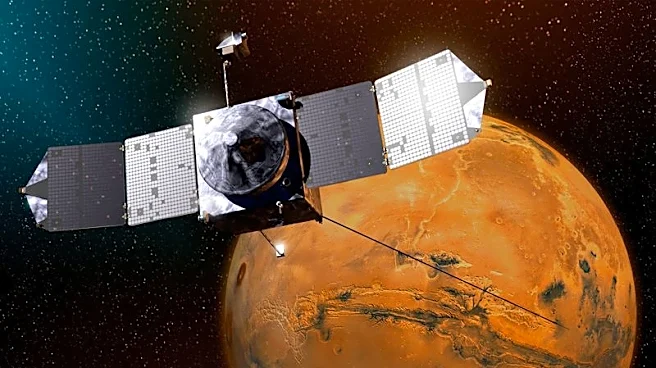
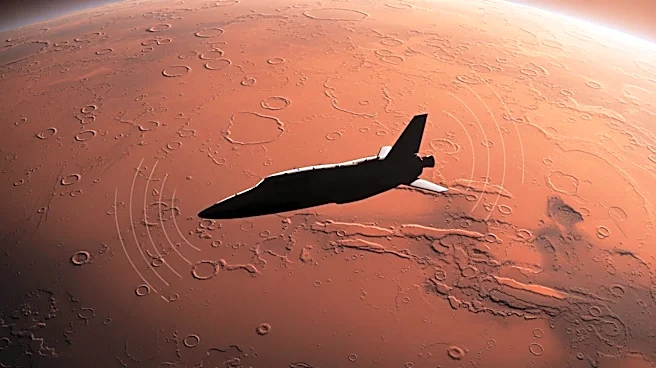
NASA has officially ended the Mars Atmosphere and Volatile Evolution (MAVEN) mission after 11 years of operation. Originally launched in November 2013, MAVEN was tasked with studying the Martian atmosphere and its interactions with solar wind. The mission,
which lasted a decade longer than initially planned, provided significant insights into how Mars lost much of its atmosphere and surface water billions of years ago. Despite efforts to reestablish communication after a signal loss in December 2025, NASA's review board determined that the spacecraft was in an unrecoverable state. MAVEN's achievements include measuring atmospheric sputtering, observing solar wind effects, and studying Martian dust storms, all of which have contributed to understanding planetary habitability and atmospheric loss.
Why It's Important?
The MAVEN mission has been pivotal in advancing our understanding of Mars and its atmospheric dynamics. By revealing how solar wind and space weather contribute to atmospheric loss, MAVEN has provided crucial data that informs future human exploration of Mars. The mission's findings on atmospheric sputtering and dust storms have implications for understanding climate change on Mars and the potential for past habitability. These insights are essential for planning future missions and ensuring the safety of astronauts who may one day travel to Mars. The data collected will continue to be a valuable resource for scientists studying planetary atmospheres and the conditions necessary for life.
What's Next?
NASA has begun the decommissioning process for the MAVEN mission and is archiving the full dataset, which will be made available to the scientific community. This data has already led to the publication of over 800 scientific papers, with more expected as researchers continue to analyze the information. The insights gained from MAVEN will guide future Mars missions and contribute to the broader understanding of planetary science. As NASA and other space agencies plan for human exploration of Mars, the lessons learned from MAVEN will be instrumental in developing strategies for dealing with the planet's harsh environment.