






What's Happening?
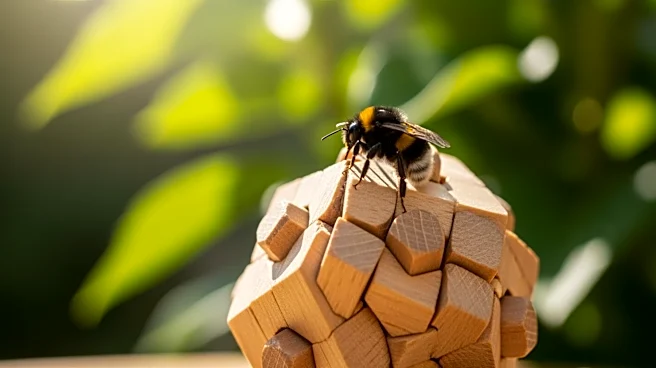
Recent research conducted by Olli Loukola, a behavioral ecologist at the University of Turku in Finland, has revealed that bumblebees, despite their small brain size, can solve complex problems similar to those solved by larger animals like chimpanzees
and elephants. The study, published in the journal Science, involved training bumblebees to associate a blue circle with a sweet reward. The bees were then observed moving a small Styrofoam ball beneath the blue circle to reach the reward, demonstrating a level of cognitive flexibility previously thought to be beyond their capabilities. This experiment was inspired by Wolfgang Köhler's classic experiment with chimpanzees, where the animals stacked boxes to reach a banana. Loukola's findings suggest that bumblebees can engage in spontaneous problem-solving, challenging the assumption that larger brains are necessary for complex cognitive tasks.
Why It's Important?
The discovery that bumblebees can solve complex problems has significant implications for our understanding of animal cognition and the evolution of intelligence. It challenges the traditional view that larger brains are required for sophisticated problem-solving abilities, suggesting that cognitive flexibility can exist in much smaller creatures. This could lead to a reevaluation of how intelligence is measured across different species. Additionally, understanding the cognitive abilities of bumblebees could have practical applications in fields such as robotics and artificial intelligence, where mimicking natural problem-solving strategies could enhance machine learning algorithms. The study also highlights the importance of preserving bee populations, as their ability to adapt to changing environments is crucial for pollination and ecosystem health.
What's Next?
Future research by Loukola and his team aims to explore the limits of bumblebee cognition further. They plan to investigate the insects' body movements and microgestures to determine if there are any indicators of problem-solving insight. Additionally, there is interest in imaging the bumblebee brain during problem-solving tasks to gain a deeper understanding of their cognitive processes. These studies could provide more insights into the neural mechanisms underlying problem-solving in small-brained animals and potentially lead to new approaches in artificial intelligence development.
Beyond the Headlines
The findings from this study could have broader implications for conservation efforts, as they underscore the cognitive capabilities of insects, which are often overlooked in discussions about biodiversity. Recognizing the intelligence of bumblebees may lead to increased efforts to protect their habitats and ensure their survival, given their critical role in pollination and maintaining ecological balance. Furthermore, this research could inspire a shift in how we perceive and value different forms of intelligence in the animal kingdom, promoting a more inclusive understanding of cognitive diversity.