

What's Happening?
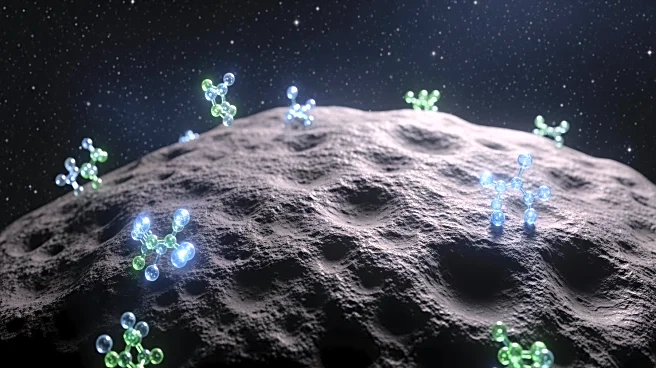
Researchers from Penn State University have discovered that amino acids found in samples from the Bennu asteroid, delivered to Earth by NASA's OSIRIS-REx mission, may have formed under different conditions than previously thought. The study, published
in the Proceedings of the National Academy of Sciences, suggests that these building blocks of life could have originated in icy-cold, radioactive environments at the dawn of the solar system. The research challenges the traditional view that amino acids form in warm, liquid water environments, indicating a broader range of conditions for their formation. The team used specialized instruments to analyze isotopic variations in the samples, revealing that Bennu's amino acids may have formed in frozen ice exposed to radiation.
Why It's Important?
This discovery has significant implications for understanding the origins of life on Earth and the potential for life elsewhere in the universe. By demonstrating that amino acids can form in a variety of conditions, the study expands the possibilities for where and how life's building blocks might arise. This could influence future space missions and the search for extraterrestrial life, as scientists may need to consider a wider range of environments when looking for signs of life. The findings also suggest that the early solar system was more chemically diverse than previously believed, which could lead to new insights into the formation of planets and the conditions that support life.