



What's Happening?
A recent study presented at the European Geosciences Union General Assembly in Vienna proposes that Dante Alighieri's depiction of Hell in his 14th-century work, 'Inferno,' mirrors the structure of a large planetary impact crater. Led by Dr. Iain Stewart
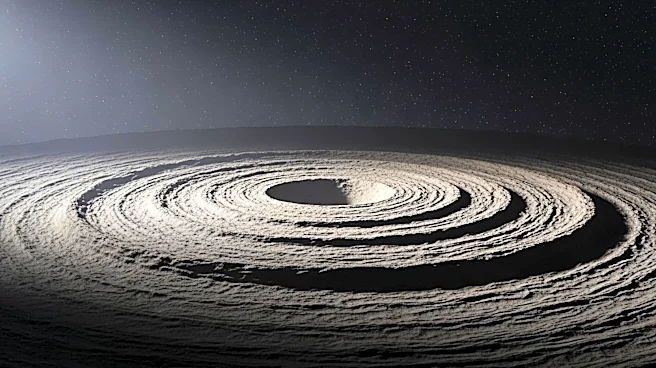
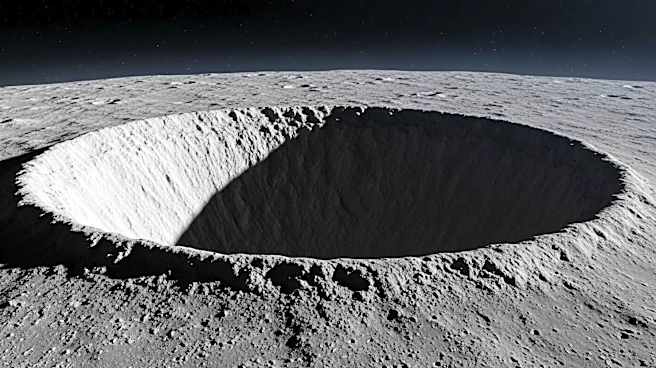
from the University of Plymouth, the research suggests that Dante's description of Hell as a vast, inverted conical pit with nine concentric circles resembles the features of a 'complex impact crater.' These craters, formed by massive asteroid impacts, have terraced inner walls, a central uplift, and a broad, flat floor, similar to Dante's layered underworld. The study highlights the Chicxulub crater, known for its role in the extinction of the dinosaurs, as a real-world example of such a structure. The researchers argue that Dante's work may reflect an intuitive understanding of planetary physics, despite being written centuries before modern science could describe these phenomena.
Why It's Important?
This study is significant as it bridges literature and science, suggesting that medieval texts may contain advanced natural knowledge. If Dante's 'Inferno' indeed reflects the structure of an impact crater, it implies that historical literature could offer insights into ancient understandings of natural events. This could influence how scholars interpret other historical texts, potentially uncovering more instances where pre-modern works align with scientific principles. The research also underscores the value of interdisciplinary studies, combining literary analysis with geophysical science to explore new interpretations of classical works. Such findings could inspire further investigations into how ancient and medieval cultures perceived and recorded natural phenomena.
What's Next?
The study's authors acknowledge that their hypothesis remains speculative and has not yet been published in a peer-reviewed journal. Future research may involve more detailed comparisons between Dante's descriptions and known impact craters, as well as exploring other historical texts for similar scientific insights. The academic community may respond with further studies to either support or refute these claims, potentially leading to a broader acceptance of the idea that ancient literature can contain scientific knowledge. Additionally, this research could prompt a reevaluation of how classical texts are taught, emphasizing their potential scientific relevance alongside their literary and historical significance.