




What's Happening?
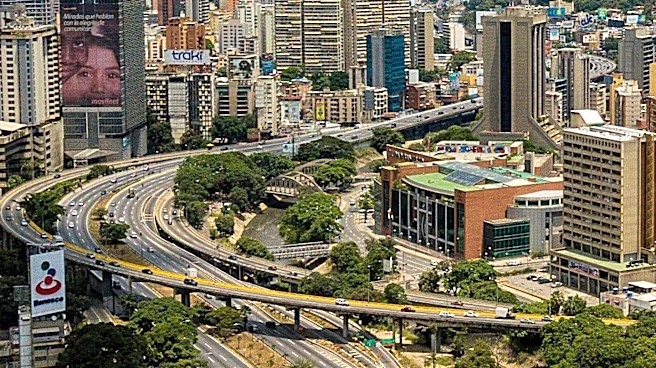
New research by Michele Fioretti, Kavanaugh FitzPatrick, and Alessandro Iaria indicates that U.S. sanctions on Venezuela's oil industry have led to a significant increase in pollution per barrel of oil produced, despite a two-thirds drop in overall oil output.
Financial sanctions were imposed in August 2017, followed by cutting off the state oil company, PDVSA, from the dollar system in January 2019. While Venezuela's oil output declined substantially, the gas flared per barrel more than doubled. The study, which compared Venezuela's oil output and emissions with five unsanctioned Latin American countries from 2012 to 2024, found that the reduction in trade of specialized equipment and spare parts due to sanctions eroded the production process. This erosion resulted in remaining oil production generating more emissions per barrel than before the sanctions. The research attributes this increase in pollution primarily to 'strain' on the system and deferred 'maintenance,' as the sanctions limited access to diluents, spare parts, and service contractors necessary for efficient and environmentally sound operations.
Why It's Important?
This research highlights an unintended and significant environmental consequence of U.S. sanctions policy, particularly in the oil sector. While sanctions aim to exert political pressure by denying revenue to governments, they can inadvertently exacerbate environmental damage. The findings suggest that the design of sanctions regimes needs to consider potential ecological impacts, especially in industries like oil extraction where specialized equipment and maintenance are crucial for mitigating pollution. The increased flaring and venting of gas, including methane—a potent greenhouse gas—contributes to climate change, creating a global externality from a targeted national policy. This situation also underscores the complex interplay between geopolitical strategies and environmental sustainability, demonstrating that economic restrictions can have far-reaching and undesirable side effects beyond their intended scope. The estimated climate damage from Venezuela's oil sector, partly attributed to sanctions, amounts to billions of dollars annually, representing a substantial hidden cost.
What's Next?
The research suggests a policy implication: the need for an 'environmental carve-out' in sanctions regimes. This would involve licensing the upkeep of oil fields, including compressor parts, leak repair, gas capture and reinjection equipment, and diluents, while still restricting drilling and lifting services. Such a license would be conditional on verifiable results, with flaring at licensed fields checked by satellite. However, the authors note that flaring alone is insufficient, as gas could be vented instead, requiring operators to meter and report captured gas. The U.S. Treasury Department has since reopened the Venezuelan oil sector through general licenses, permitting diluent and repairs, and allowing production growth. However, these licenses do not explicitly mention methane, flaring, venting, or emissions, raising concerns that the environmental impact might not be adequately addressed. Future policy discussions may need to balance political objectives with environmental protection, potentially leading to more nuanced sanctions frameworks that incorporate ecological considerations.
Beyond the Headlines
The case of Venezuela's oil industry under U.S. sanctions reveals a deeper ethical and practical dilemma in international relations: how to apply economic pressure without causing undue environmental harm. The study's findings challenge the assumption that reduced oil output automatically translates to reduced environmental impact. Instead, it demonstrates that the manner of production, heavily influenced by access to maintenance and technology, is critical. This raises questions about the long-term responsibility of sanctioning nations for the environmental degradation that may occur in targeted countries. It also highlights the difficulty of separating political aims from their broader societal and ecological consequences. The potential for sanctions to create 'dirty oil' production could lead to calls for international bodies to establish guidelines or oversight mechanisms for environmental protection within sanctioned industries, ensuring that geopolitical tools do not inadvertently undermine global climate goals.