






What's Happening?
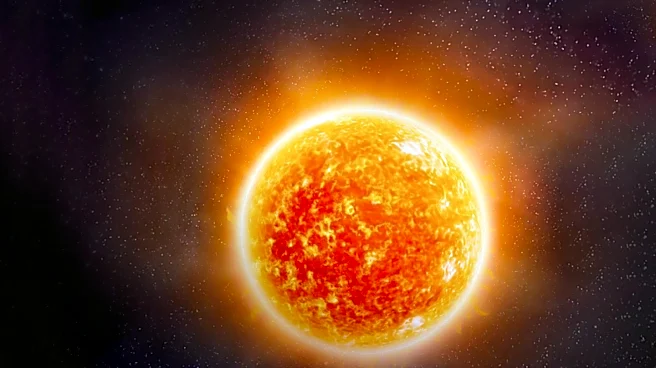
A recent study using advanced stellar evolution models suggests that Earth might survive the sun's transformation into a red giant, a phase expected to occur in about 5 billion years. As the sun expands, it will exert increased tidal forces on Earth,
pulling it closer. However, the sun will also lose mass through stellar winds, weakening its gravitational pull and potentially allowing Earth to move to a safer orbit. This delicate balance between tidal forces and mass loss will determine Earth's fate. Observations of a nearby dying star, L2 Puppis, which is losing mass and possibly harboring a planet, provide insights into this process. The study, published in Astronomy & Astrophysics, highlights the uncertainty surrounding the sun's future mass loss and its impact on Earth's survival.
Why It's Important?
The findings of this study have significant implications for understanding the long-term future of Earth and the solar system. If Earth survives the sun's red giant phase, it could continue to exist in a new, stable orbit, potentially allowing life to persist in some form. This research also contributes to the broader understanding of stellar evolution and the fate of planets orbiting aging stars. The study underscores the importance of continued astronomical observations and modeling to refine predictions about the sun's behavior and its impact on the solar system. The potential survival of Earth offers a glimmer of hope for the planet's long-term habitability, even as other inner planets like Mercury and Venus are expected to be engulfed by the expanding sun.
What's Next?
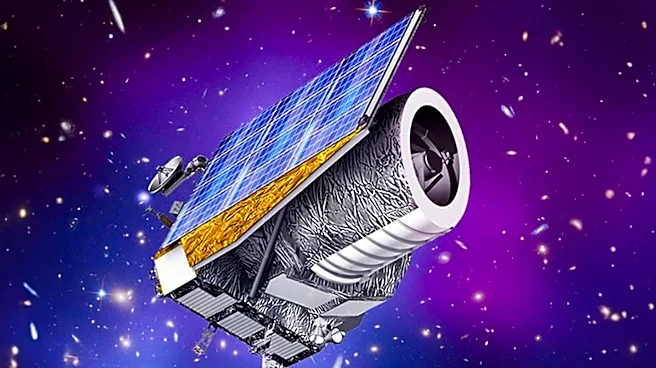
Future research and observations are needed to better understand the sun's mass loss and its effects on Earth's orbit. The European Space Agency's upcoming PLATO mission, set to launch next year, aims to detect planets around aging stars, which could provide more accurate data on the survival of planets like Earth. Improved models and observations will help clarify the potential outcomes for Earth and other planets in the solar system. As scientists gather more data, they will be able to make more precise predictions about the sun's evolution and its impact on the solar system's dynamics.