
What's Happening?
India and the United States are in the process of negotiating a trade agreement expected to be formalized in early 2026. The deal aims to reduce tariffs and expand market access for goods traded between
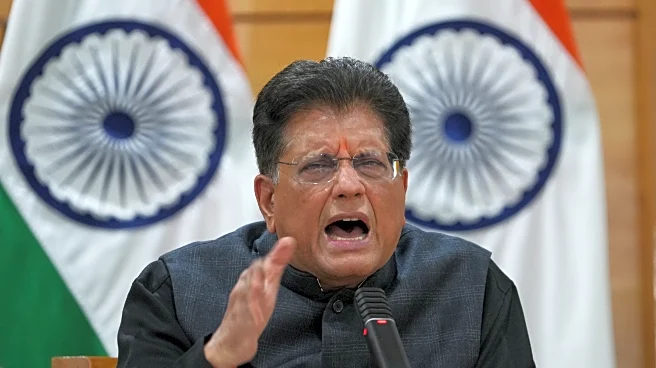
the two countries. Reports indicate that the U.S. will lower the reciprocal tariff on Indian products from around 50% to 18%, while India is considering phased tariff cuts on selected U.S. goods. The agreement seeks to strengthen economic cooperation without compromising sensitive sectors such as agriculture and dairy. Indian officials, including Union Agriculture and Farmers’ Welfare Minister Shivraj Singh Chouhan, have assured that the trade pact will not harm Indian farmers or their produce. Commerce and Industry Minister Piyush Goyal emphasized that the deal's framework balances opening markets for Indian exports while safeguarding farmers' interests.
Why It's Important?
The India-U.S. trade deal is significant as it could substantially boost bilateral commerce by reducing tariffs and non-tariff barriers on manufactured and industrial products. This expansion is expected to benefit sectors such as textiles, chemicals, machinery, and electronics. The deal also holds geopolitical importance, reinforcing strategic ties and signaling deeper economic integration between the two nations. However, the agreement has sparked debate in India, with opposition parties and farmers' groups expressing concerns about potential impacts on domestic agriculture. The government maintains that the fears are speculative and that protective measures for farmers are in place.
What's Next?
As negotiations continue, a joint statement and the full legal text of the agreement are expected to be released once final technical and legal procedures are completed. This transparency is anticipated to clarify how protective measures for farmers and other sensitive industries will be implemented. Stakeholders from government, industry, and civil society will closely monitor the finalization of the deal to ensure that it aligns with the interests of India's agricultural communities.