
What's Happening?
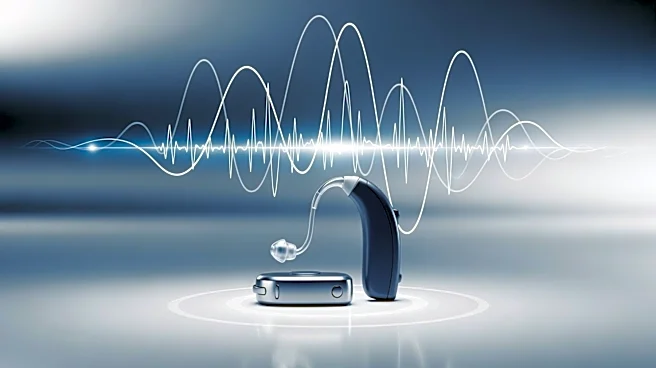
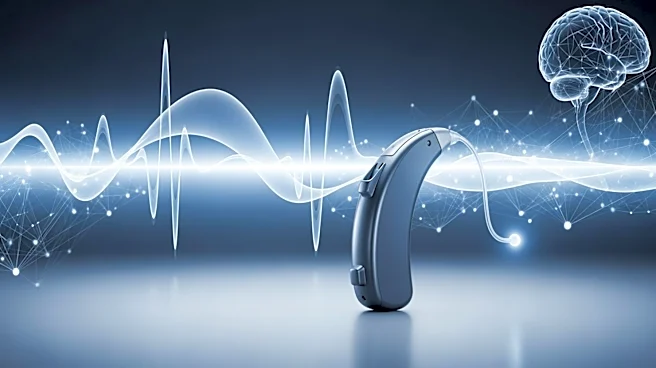
Researchers have developed a brain-controlled hearing aid system that could significantly improve the ability of people with hearing loss to focus on specific voices in noisy environments. This system,
described in the journal Nature Neuroscience, decodes brain waves to determine which voice a person wants to hear, amplifying that voice while reducing background noise. The technology was tested on individuals with typical hearing, showing a 90% success rate in identifying the desired voice. The system uses electrodes to monitor brain activity, adjusting audio output based on the listener's focus. This innovation addresses the 'cocktail party problem,' where hearing aids struggle to isolate a single voice in a crowded setting.
Why It's Important?
This development is crucial as it addresses a significant limitation of current hearing aids, which often fail to distinguish between competing voices in noisy environments. With over half of people aged 75 and older experiencing disabling hearing loss, the potential for improved hearing aids could enhance the quality of life for millions. The technology could lead to advancements in hearing aids, assistive listening devices, and cochlear implants, offering a more personalized and effective hearing solution. The research also highlights the growing intersection of neuroscience and technology, paving the way for future innovations in auditory assistance.
What's Next?
The next steps involve testing the system on individuals with hearing loss to determine its effectiveness in real-world scenarios. Researchers aim to refine the technology to ensure it can accurately read brain waves in those with weaker signals due to hearing impairment. There is also potential for integrating artificial intelligence to predict and enhance the system's ability to focus on the desired voice. As the demand for advanced hearing solutions grows, further research and development could lead to commercial availability, offering a new standard in hearing aid technology.