






What's Happening?
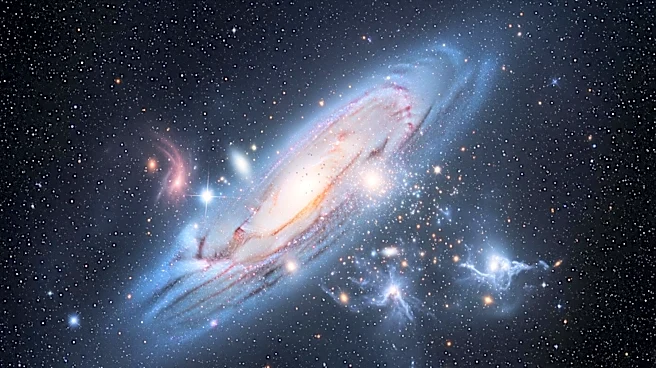
Astronomers have identified 20 unusual metal-poor stars near the Milky Way’s disk, believed to be remnants of an ancient dwarf galaxy. This galaxy, nicknamed Loki after the Norse trickster god, was consumed by the Milky Way approximately 10 billion years
ago. The discovery, made using data from the European Space Agency’s Gaia telescope and the Canada-France-Hawaii Telescope, provides insight into the Milky Way's formation history. These stars, located about 7,000 light-years from our solar system, exhibit similar chemical compositions, suggesting they originated from the same galaxy. The study, published in the Monthly Notices of the Royal Astronomical Society, highlights the Milky Way's growth through the absorption of smaller galaxies over billions of years.
Why It's Important?
This discovery is significant as it sheds light on the Milky Way's evolutionary history, revealing a previously overlooked aspect of its formation. Understanding the remnants of galaxies consumed by the Milky Way helps astronomers piece together the galaxy's past and its growth through cosmic cannibalism. The findings suggest that the Milky Way's current structure and stability may have been influenced by such mergers, which could have reset its early turbulent phase. This research could lead to a reevaluation of the Milky Way's formation history and provide a deeper understanding of galactic evolution.
What's Next?
Future research will likely focus on further investigating the remnants of the Loki galaxy and other potential merger events within the Milky Way. Astronomers may use larger datasets to confirm the existence of Loki and explore its impact on the Milky Way's development. This could involve revisiting current models of the galaxy's formation to incorporate these new findings. Additionally, the study may inspire further exploration of other ancient galaxies that contributed to the Milky Way's growth, enhancing our understanding of the universe's history.
Beyond the Headlines
The discovery of the Loki galaxy's remnants highlights the complex and dynamic nature of galactic evolution. It underscores the importance of studying metal-poor stars as they hold clues to the universe's earliest generations of stars. This research also emphasizes the role of cosmic cannibalism in shaping galaxies, offering a glimpse into the processes that have influenced the Milky Way's structure and composition over billions of years. The findings may prompt a reevaluation of how astronomers search for and interpret evidence of past galactic mergers.