





What's Happening?
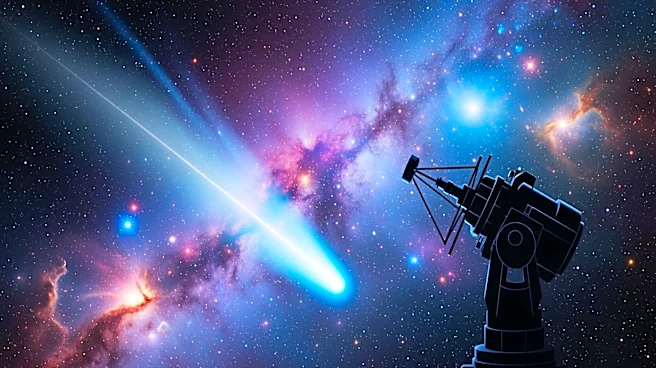
NASA has released findings from the James Webb Space Telescope's observations of the interstellar comet 3I/ATLAS. The data confirms that this comet, observed in late 2025, is unlike any found in our Solar System. Webb's observations revealed the presence
of methane gas, marking the first direct detection of methane in an interstellar object. The comet's unique composition suggests it formed in a distant part of the galaxy, distinct from the conditions in our Solar System. This discovery adds to the limited number of known interstellar objects, providing a rare opportunity to study materials from beyond our Solar System.
Why It's Important?
The discovery of comet 3I/ATLAS's unique characteristics is crucial for understanding the diversity of celestial bodies in the universe. By analyzing its composition, scientists gain insights into the conditions of distant regions of the galaxy, which differ significantly from those in our Solar System. This information can enhance our understanding of the formation and evolution of comets and other interstellar objects. The findings also highlight the capabilities of the James Webb Space Telescope in detecting and analyzing distant cosmic phenomena, reinforcing its role in advancing astronomical research and expanding our knowledge of the universe.