


What's Happening?
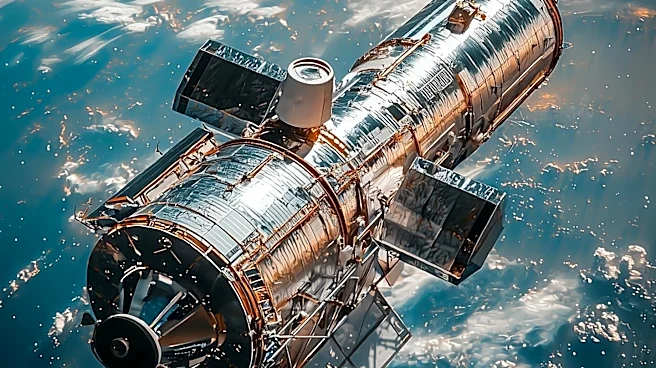
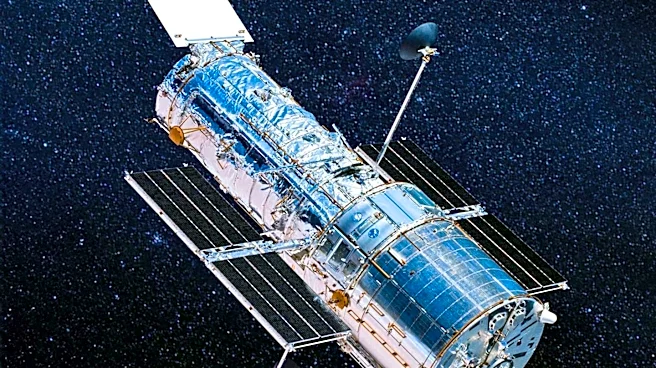
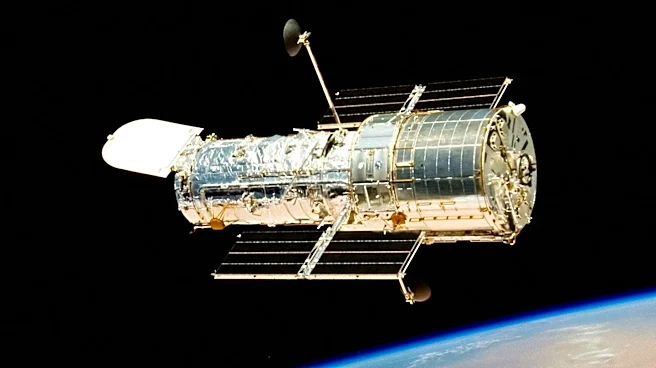
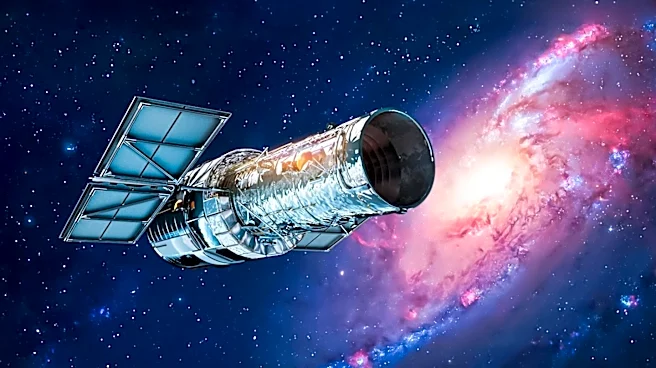
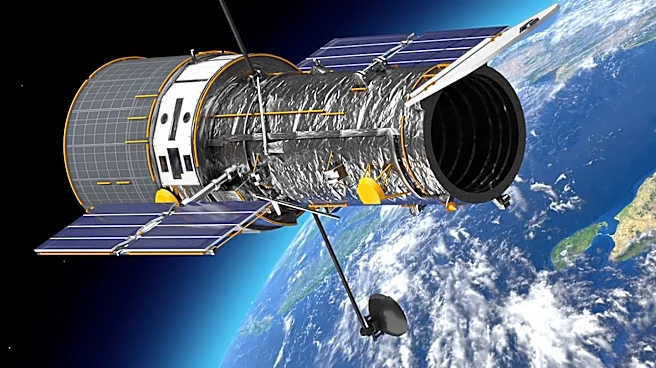
Astronomers at the University of Arizona, utilizing the Hubble Space Telescope, have made a significant discovery: a gargantuan, 93-billion-mile-long cosmic dust feature dubbed the 'Cat's Tail.' This structure is located in the Beta Pictoris system, approximately
63 light-years away. Previously, this anomaly was only detectable by NASA's James Webb Space Telescope in infrared light. Lead researcher Arin Avsar explained that the 'Cat's Tail' evaded visible-light detection for so long because it is composed almost entirely of heavily carbon-based organic refractory material, which effectively absorbs visible light. The structure is roughly 1,000 astronomical units long, equivalent to wrapping between the Earth and the Sun about 500 times.
Why It's Important?
This discovery is crucial for advancing our understanding of planetary formation and the composition of cosmic dust. The 'Cat's Tail' provides astronomers with a unique opportunity to study the aftermath of potential celestial collisions and the processes that lead to the creation of such vast structures. The fact that it was only recently observed in visible light by Hubble, after being seen in infrared by JWST, highlights the complementary nature of different telescope technologies and their respective observational capabilities. Understanding the composition and formation of this carbon-rich dust can offer insights into the building blocks of planets and the early stages of solar system development, potentially shedding light on how our own celestial neighborhood formed billions of years ago. The unexplained nature of its formation also opens new avenues for theoretical astrophysics and observational research.
What's Next?
Researchers are continuing to analyze the 14 years of Hubble data, combined with JWST's infrared scans, to further map the 'Cat's Tail' in 3D. They have already identified a gravitational warp in the dust halo, likely caused by Beta Pictoris b, a gas giant significantly larger than Jupiter. Future research will focus on developing more concrete explanations for the formation of this immense structure. One leading hypothesis suggests it may have formed after two Pluto-sized planetoids collided at high speeds, vaporizing carbon into gas that later cooled into porous cosmic dust. Continued observations and theoretical modeling will be essential to confirm this or other hypotheses, potentially leading to a revised understanding of protoplanetary disk dynamics and the evolution of young star systems.
Beyond the Headlines
The 'Cat's Tail' discovery has broader implications for the search for exoplanets and the study of debris disks around other stars. The presence of such a massive and complex dust structure suggests that the processes of planetary formation can be highly dynamic and potentially violent. It also emphasizes the importance of multi-wavelength astronomy, as different telescopes reveal different aspects of cosmic phenomena. The unexplained aspects of the 'Cat's Tail' serve as a reminder of the vast unknowns in the universe and the continuous need for advanced observational tools and innovative scientific inquiry. This finding could inspire new models for how dust and gas interact in young stellar systems, influencing our understanding of where and how planets, including potentially habitable ones, might form.