






What's Happening?
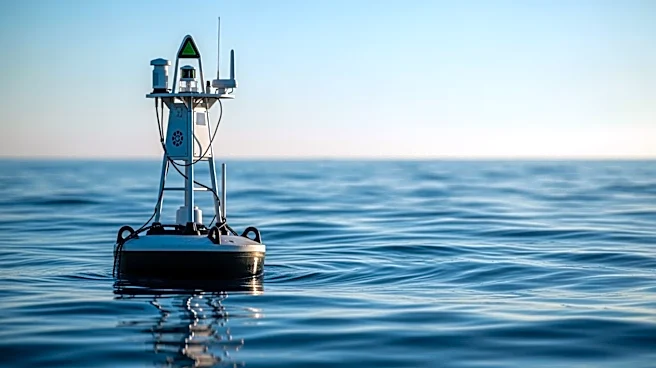
The Trump administration has initiated a significant reduction of the Ocean Observatories Initiative (OOI), a $368 million ocean monitoring system. The National Science Foundation (NSF) announced the removal of over 900 instruments from key observing
arrays in the Atlantic and Pacific Oceans, including the Irminger Sea off Greenland. This descoping will phase out real-time data collection, which has been crucial for tracking ocean temperatures, carbon absorption, and coastal impacts. Critics argue that this move undermines climate research and U.S. scientific capacity. The NSF, while maintaining that the OOI is not being canceled, stated that the decision aligns with evolving scientific priorities and lifecycle management strategies.
Why It's Important?
The descoping of the OOI is significant as it affects the ability to monitor and understand climate-driven changes in ocean conditions. The data collected by the OOI has been vital for predicting climate impacts, such as warming waters and rising coastal risks. The reduction in monitoring capabilities could hinder the U.S.'s ability to respond to environmental challenges and maintain its leadership in global scientific research. Environmental groups and scientists have criticized the decision, emphasizing the importance of continuous data for understanding and mitigating climate change impacts.
What's Next?
The descoping process is already underway, with equipment recovery scheduled through 2027. The NSF has assured that previously collected data will remain accessible, but the OOI Data Center will operate only until September 2028. Critics are urging Congress to intervene to prevent further cuts to ocean science programs. The decision reflects broader trends of reduced federal support for scientific research under the Trump administration, raising concerns about the future of U.S. environmental and climate research capabilities.