
What's Happening?
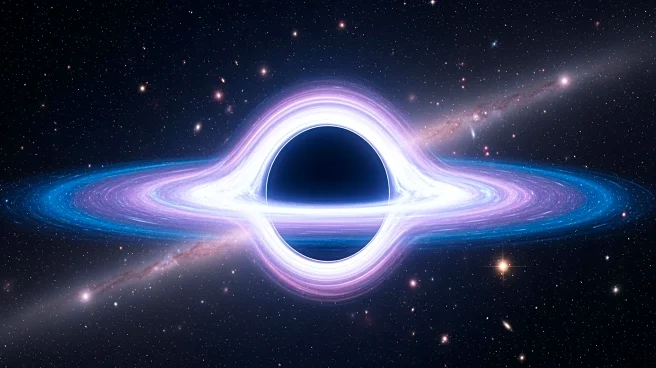
The James Webb Space Telescope (JWST) has made a significant discovery by identifying a rapidly growing supermassive black hole in the early universe. This black hole, located in the galaxy CANUCS-LRD-z8.6,
was found to exist just 570 million years after the Big Bang. The discovery was announced by astronomers in November 2025, highlighting the black hole's unexpected rapid growth in such an early galaxy. The JWST, which began its observations in 2022, has been instrumental in uncovering these 'little red dot' galaxies, which are small, bright, and extremely distant. The discovery challenges existing theories about black hole and galaxy formation in the early universe, as it was previously thought that such rapid growth would not occur in these early stages.
Why It's Important?
This discovery is crucial as it challenges current understanding of black hole and galaxy formation in the early universe. The rapid growth of the black hole in CANUCS-LRD-z8.6 suggests that black holes could have formed and evolved much faster than previously believed. This has significant implications for astrophysics, as it may require scientists to revise models of early universe evolution. The findings could lead to new research avenues exploring how such massive objects came to be so soon after the Big Bang. This could also impact our understanding of the role black holes play in galaxy formation and evolution, potentially altering the timeline of cosmic history.
What's Next?
Following this discovery, astronomers are likely to conduct further observations using the JWST and other telescopes to explore similar galaxies and black holes. These studies will aim to gather more data on the formation and growth rates of black holes in the early universe. Additionally, researchers may develop new theoretical models to better understand the processes that allow for such rapid growth. The scientific community will be keen to see if similar phenomena are observed in other early galaxies, which could confirm or challenge the findings from CANUCS-LRD-z8.6.