




What's Happening?
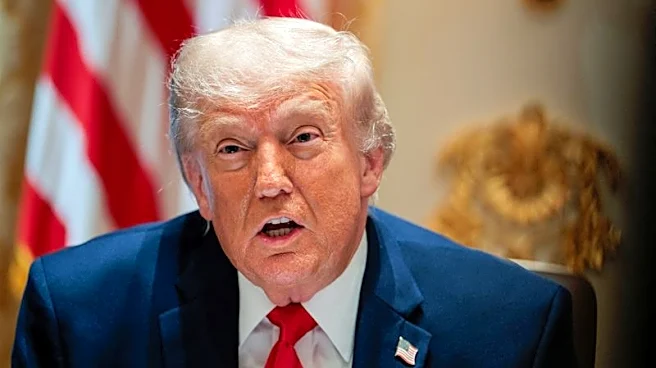
A recent analysis by The New York Times reveals that officials in President Trump's Cabinet meetings spend at least one out of every six sentences praising him. This level of public flattery is considered historically unusual. The analysis compared televised
Cabinet meetings from Trump's first term to those in his second term, noting a shift from occasional pushback to more consistent praise. Statements from Cabinet officials often echo Trump's public claims, such as assertions that certain international conflicts would not have occurred under his leadership. This environment of flattery contrasts with national polls showing low approval ratings for Trump during his second term. Experts suggest that this approach deviates from presidential norms, where dissent and diverse opinions are typically encouraged to foster sound policy decisions.
Why It's Important?
The emphasis on flattery in President Trump's Cabinet meetings raises concerns about the quality of decision-making within the administration. Experts argue that while loyalty may benefit a president's ego, it rarely leads to the candid advice necessary for effective governance. The lack of dissenting voices could result in less robust policy outcomes, as diverse perspectives are crucial for generating innovative solutions. This approach also highlights a broader trend of prioritizing loyalty over expertise, which could have long-term implications for the functioning of the executive branch. The decision to televise full Cabinet meetings further complicates the issue, as it may pressure officials to perform for the public rather than engage in sincere deliberation.
What's Next?
President Trump is set to hold the next Cabinet meeting on Wednesday, which will be a rare closed-door session focused on foreign policy. The ongoing emphasis on loyalty and flattery may continue to shape the administration's approach to governance, potentially affecting the quality of policy decisions. As the administration navigates complex domestic and international challenges, the lack of diverse viewpoints could hinder its ability to respond effectively. Observers will be watching to see if this trend persists and how it impacts the administration's ability to achieve its policy goals.
Beyond the Headlines
The culture of flattery within President Trump's Cabinet meetings may have deeper implications for the administration's ability to process information and make informed decisions. Research suggests that homogeneous groups, where dissent is minimized, tend to produce lower quality solutions. This environment could reduce the administration's capacity for critical thinking and problem-solving, ultimately affecting its ability to address complex issues. The emphasis on loyalty over expertise may also impact the administration's ability to attract and retain talented individuals, further limiting its effectiveness.