
What's Happening?
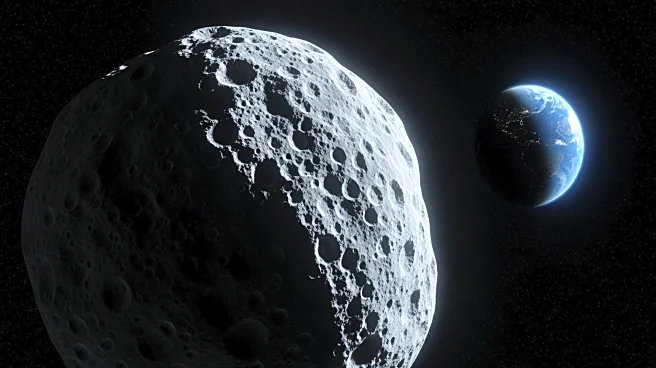
Asteroid Apophis is set to pass within approximately 32,000 kilometers of Earth's surface on April 13, 2029. This close approach has prompted scientific interest due to its proximity, which is closer than
many geostationary satellites. The European Space Agency (ESA) and Japan are planning the Ramses mission, which will include a Swiss-built camera from the University of Bern to study the asteroid's interaction with Earth's gravity. NASA's OSIRIS-APEX spacecraft is also set to observe Apophis during its flyby. The asteroid, discovered in 2004, was initially thought to pose a collision risk, but further observations have ruled out any impact threat for at least the next century.
Why It's Important?
The flyby of Apophis presents a unique opportunity for scientists to study the effects of Earth's gravity on an asteroid's physical state. This research could provide valuable insights into planetary defense strategies, as understanding how asteroids behave when influenced by Earth's gravity is crucial for developing methods to deflect potential future threats. The mission also highlights international collaboration in space exploration, with contributions from ESA, NASA, and the University of Bern. The data collected could enhance our understanding of asteroid composition and behavior, which is vital for both scientific knowledge and planetary safety.
What's Next?
As the 2029 flyby approaches, preparations for the Ramses mission and the OSIRIS-APEX observations will intensify. Scientists will refine their plans to maximize the data collected during the event. The University of Bern's CHANCES camera will focus on capturing high-resolution images to detect changes on Apophis' surface. Meanwhile, NASA's OSIRIS-APEX may use its thrusters to disturb the asteroid's surface, allowing for a deeper analysis of its composition. These efforts will contribute to the broader planetary defense initiatives aimed at protecting Earth from potential asteroid impacts.