




What's Happening?
An international collaboration involving dozens of labs and hundreds of scientists across nine countries and over 50 institutions has unveiled the most detailed and comprehensive multi-species cellular atlas of the basal ganglia. This expansive library
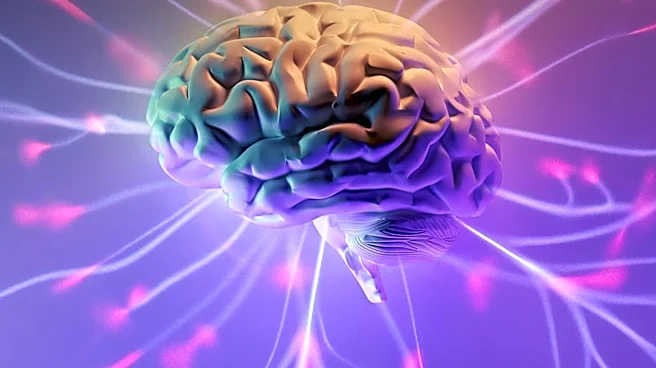
of brain cell types and datasets, spanning human, macaque, marmoset, and mouse brains, was published in a package of 26 studies in the Cell Press family of journals. Researchers utilized advanced single-cell molecular profiling technologies to measure the genetic expression of 25.5 million individual cells, including 21.0 million from humans. This effort represents the first major working model of a standardized, cross-species brain cell reference atlas. The basal ganglia, a set of structures deep within the brain, are crucial for movement, habit formation, decision-making, and emotion, and are implicated in conditions like Parkinson’s disease, Huntington’s disease, schizophrenia, bipolar disorder, and addiction. This atlas is also the first major output of the BRAIN Initiative Cell Atlas Network (BICAN), which aims to create a complete atlas of all cell types in the entire human brain.
Why It's Important?
This landmark cellular atlas provides a foundational resource for understanding brain function and dysfunction, with significant implications for neurological and psychiatric disorders. By offering an accurate, cell-type-specific list and examining individual gene expression, scientists can better understand the cellular underpinnings of diseases. For instance, the research identified a new brain cell type, STR D2 SMYD2-HTR7, linked to schizophrenia and bipolar disorder, narrowing down genetic disease signals to a specific population for targeted research. Another study developed a more effective and less invasive gene therapy for Parkinson’s disease in animal models. Insights into genetic changes in specific basal ganglia cell types could also lead to new treatments for autism. The atlas establishes a common reference system and language for neuroscience, fostering team science and open science, which is expected to accelerate progress in understanding and treating complex brain diseases that have historically stumped medical science.
What's Next?
The BRAIN Initiative Cell Atlas Network (BICAN) will continue its endeavor to map the entire human brain, building upon the framework established by this basal ganglia atlas. All data and findings from this project will be openly shared with the global scientific community, providing tools for researchers to access, visualize, and mine the data, and to map their own data onto this system. This open philosophy and collaborative framework are expected to catalyze further discoveries and advance human health beyond the basal ganglia. The insights gained from this atlas have the potential to reveal the underlying causes of many diseases and disorders, though the development and testing of new therapies will require time. Future artificial intelligence models could leverage this atlas to predict how disease-associated genetic variants alter gene regulation and cell function, potentially enabling early intervention before symptoms appear.
Beyond the Headlines
The creation of this comprehensive brain cell atlas signifies a major shift towards a more integrated and collaborative approach in neuroscience. By establishing a common standard and language for classifying and analyzing brain complexity, the project aims to unify the scientific community, much like the Human Genome Project did for genetics. This collaborative model, involving diverse expertise from scientists, engineers, and technicians, highlights the power of team science in tackling complex biological challenges. The ethical implications of such detailed brain mapping include considerations for data privacy and the responsible use of genetic information. Culturally, this advancement could reshape our understanding of human identity and consciousness by providing unprecedented insights into the brain's fundamental building blocks. The long-term impact could be a paradigm shift in how neurological and psychiatric conditions are diagnosed, treated, and potentially prevented, moving towards highly personalized and cell-type-specific interventions.