





What's Happening?
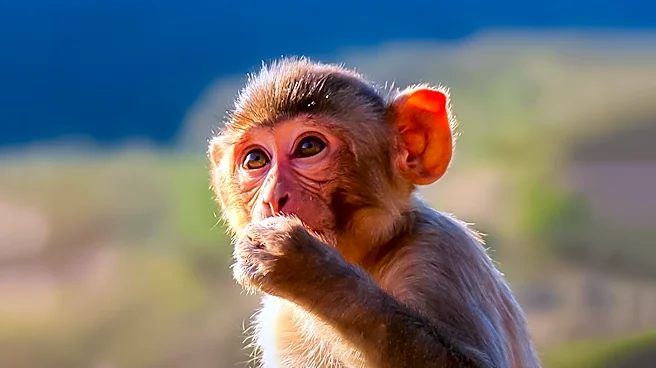
New research indicates that macaques at a Texas sanctuary developed heightened germophobic behaviors after experiencing a viral outbreak, similar to human responses during the COVID-19 pandemic. Scientists, led by cognitive scientist Stephan Kaufhold
of UC San Diego, observed that macaques who lived through an outbreak of an HIV-like virus (SRV) were significantly more cautious about consuming food placed on simulated feces compared to those who had not experienced the outbreak. In experiments conducted between 2022 and 2024, only 47% of outbreak-veteran macaques ate a grape placed on epoxy-encased macaque poop, whereas 79% of macaques without outbreak exposure consumed it. This suggests an increased sensitivity to disgust and a flexible avoidance mechanism in response to disease threats.
Why It's Important?
This study provides compelling evidence for an evolutionary basis of germophobia and disease avoidance, extending beyond humans to other primates. Understanding how animals adapt their behaviors in response to pathogen threats can offer insights into the origins and mechanisms of human public health responses, such as those seen during the COVID-19 pandemic. For public health, these findings suggest that heightened caution and disgust are not merely learned behaviors but deeply ingrained evolutionary impulses to prevent sickness. This research could inform strategies for communicating health risks and promoting preventative behaviors in human populations, by tapping into these fundamental biological responses. It also highlights the broad impact of disease outbreaks on behavioral patterns across species.
What's Next?
Future research may delve deeper into the neurological and physiological underpinnings of this heightened disgust and caution in macaques, potentially identifying specific brain regions or hormonal changes associated with these behaviors. Scientists might also explore how long these behavioral changes persist and whether they are transferable to different types of threats. The findings could lead to comparative studies examining similar responses in other animal species and further elucidating the evolutionary pressures that shape disease avoidance. Additionally, this research could contribute to a better understanding of how psychological factors, such as disgust, influence human compliance with public health measures during epidemics.
Beyond the Headlines
The study's implications extend to the broader understanding of animal cognition and emotion, suggesting that complex feelings like disgust may play a more significant role in animal behavior than previously acknowledged. It challenges the notion that such nuanced responses are exclusive to humans. This research also touches upon the concept of 'preparedness' in the face of unknown threats; even without a full understanding of viral mechanisms, both humans and macaques exhibited increased caution. This evolutionary impulse to avoid potential contamination, regardless of the specific transmission route, underscores a fundamental survival strategy. It prompts reflection on how deeply ingrained biological mechanisms influence our collective and individual responses to health crises, shaping societal norms and behaviors in profound ways.