



What's Happening?
U.S. allies in Asia are expressing significant concern following the Trump administration's decision to withdraw military assets from the Asia-Pacific region to support operations in the Middle East, specifically in the ongoing conflict with Iran. This
week, the USS George Washington aircraft carrier was redeployed from Japan to the Middle East to replace the USS Abraham Lincoln, which had been on deployment for nine consecutive months. This move follows earlier revelations that the U.S. had also relocated parts of its THAAD missile defense system from South Korea for use against Iran, and reports of reduced U.S. missile and ammunition stockpiles to sustain the conflict. These actions collectively undermine the U.S.'s image of strength in Asia and its perceived ability to counter threats from China, according to William Yang, a senior analyst for Northeast Asia at the International Crisis Group. The redeployment of the USS George Washington, in particular, is seen as impacting the overall effectiveness of U.S.-led regional deterrence against China.
Why It's Important?
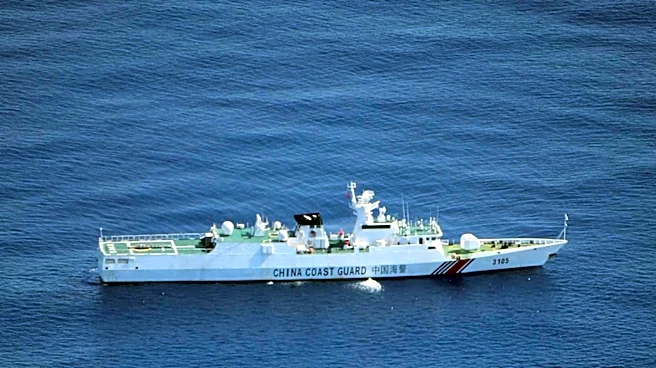
The shifting of U.S. military resources from the Asia-Pacific to the Middle East carries significant implications for regional security and U.S. alliances. According to William Yang, this trend could embolden China, leading it to become more assertive and test the boundaries of regional stability. China's naval activities have already increased, with its fleet operating more frequently beyond the 'First Island Chain,' a defensive line extending from northern Japan through Taiwan and the northern Philippines to Borneo. This increased Chinese presence, coupled with intensified Chinese coast guard activity in waters east of Taiwan that overlap with the Exclusive Economic Zones of Japan and the Philippines, suggests a growing challenge to the existing regional order. U.S. allies like South Korea, Taiwan, and Japan are already rapidly increasing their defense spending, with Taiwan announcing an 18% increase for 2027. Philippine Defense Secretary Gilberto Teodoro Jr. has called for defense spending to reach 4% of GDP to counter China. This indicates that U.S. allies are preparing to take on a greater share of their own defense, potentially leading to a more self-reliant, but also potentially more fragmented, security landscape in Asia.
What's Next?
The current U.S. strategy, as outlined in the 2026 National Defense Strategy, calls for allies and partners globally to increase their burden-sharing in addressing threats from China, North Korea, Russia, and Iran. Specifically, European and Asian allies are expected to raise defense spending to 3.5% of GDP and security-related spending to 1.5% of GDP by the 2030s. This directive suggests that the U.S. will continue to encourage its allies to enhance their autonomous defense capabilities and foster closer cooperation among themselves. While the immediate redeployment of assets to the Middle East causes short-term concern, security experts from Taiwan and Japan anticipate that U.S. interest and the presence of its aircraft carriers will eventually return to Asia. This indicates a potential cyclical pattern of U.S. military presence, influenced by global hotspots, but with a long-term commitment to the Asia-Pacific region. Allies are likely to continue increasing their defense budgets and seeking closer security partnerships with each other, even as they await a stronger, more consistent U.S. presence.
Beyond the Headlines
The U.S. military's strategic rebalancing, driven by immediate conflicts in the Middle East, highlights a broader shift in global power dynamics and the evolving nature of U.S. foreign policy. The emphasis on 'burden-sharing' with allies, while practical in terms of resource allocation, could inadvertently signal a perceived reduction in U.S. commitment, potentially leading to a more multipolar security environment in Asia. This could prompt regional powers to develop more robust independent defense capabilities and forge new alliances, possibly altering the long-standing security architecture. The increased assertiveness of China in the absence of a consistent U.S. military presence could accelerate these changes, leading to heightened regional tensions and a more complex geopolitical landscape. The long-term implications include a potential redefinition of U.S. leadership in the Indo-Pacific and a greater reliance on regional actors to maintain stability, which could have unforeseen consequences for global trade routes and economic interests.