



What's Happening?
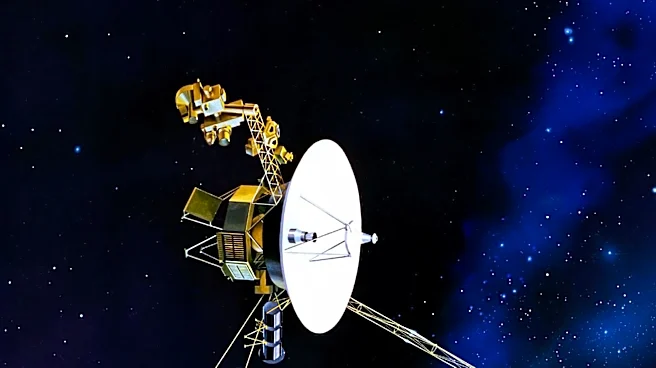
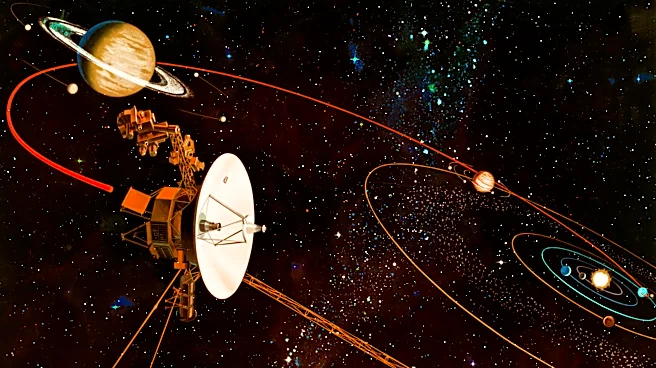
On November 18, 2026, NASA's Voyager 1 spacecraft achieved a new milestone, becoming the first human-made object to reach a distance of one light-day from Earth. This distance is approximately 16.1 billion miles. At this range, a radio command sent from NASA’s
Jet Propulsion Laboratory (JPL) takes a full day to reach Voyager 1, and another day for its reply to return, resulting in a two-day communication delay for a single exchange. Launched in 1977, Voyager 1 was originally designed for a five-year mission to explore Jupiter and Saturn. It has since far exceeded its planned lifespan, continuing to operate and send back data from interstellar space, a region no other spacecraft has explored. Voyager 1 crossed the heliopause, the boundary where solar wind gives way to the interstellar environment, on August 25, 2012, becoming the first spacecraft to enter interstellar space.
Why It's Important?
Voyager 1's continued operation and its achievement of reaching one light-day from Earth represent an extraordinary feat of engineering and scientific endurance. The spacecraft provides invaluable direct measurements of the interstellar medium, offering unique insights into the conditions of space between stars, which is crucial for understanding the broader cosmos. Its longevity, despite operating with 1970s technology and dwindling power, showcases the remarkable durability and ingenuity of its design and the dedication of the JPL teams. The data it transmits helps scientists study cosmic rays, magnetic fields, and plasma waves in a region previously inaccessible, expanding humanity's knowledge of the universe beyond our solar system. This mission continues to push the boundaries of human exploration and scientific discovery.
What's Next?
JPL engineers will continue to manage Voyager 1's operations, focusing on power conservation and maintaining communication with the distant probe. With its power output declining annually, the team faces ongoing challenges in deciding which instruments to keep operational. Currently, only the magnetometer and plasma wave instrument remain active. Future efforts will involve innovative solutions to extend the spacecraft's operational life as long as possible, extracting maximum scientific return from its remaining capabilities. The mission will eventually conclude when power levels become insufficient to operate any scientific instruments or maintain communication, but until then, Voyager 1 will continue to be humanity's most distant emissary, sending back data from the edge of interstellar space.
Beyond the Headlines
Voyager 1's journey transcends scientific data collection; it embodies humanity's innate drive for exploration and discovery. Its continued operation, nearly half a century after launch, serves as a powerful symbol of human perseverance and technological achievement. The vast communication delay highlights the immense distances involved in interstellar travel, offering a tangible perspective on the challenges of future deep-space missions. The 'Pale Blue Dot' image, captured by Voyager 1, profoundly shifted human perspective on Earth's place in the universe. The mission's legacy will continue to inspire future generations of scientists, engineers, and explorers, reminding us of our capacity to reach beyond our terrestrial confines and unravel the mysteries of the cosmos.