



What's Happening?
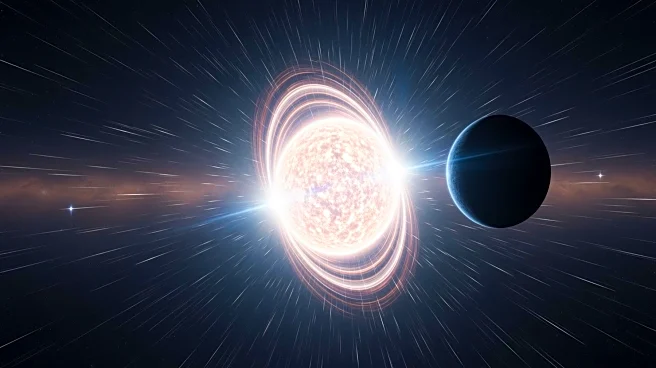
Astronomers at the University of Hawai‘i Institute for Astronomy have uncovered a peculiar red giant star in the Gaia BH2 system, which is spinning at an unusually fast rate. This star completes a full rotation every 398 days, a speed atypical for its
age. The star's rapid rotation suggests it may have merged with another star in the past, leading to its current state. Observations from NASA's Transiting Exoplanet Survey Satellite (TESS) detected faint vibrations, or 'starquakes,' within the star, allowing scientists to probe its core and measure its properties. Despite its 'alpha-rich' chemical composition, which indicates an ancient star, the star is only about 5 billion years old. This discrepancy suggests the star acquired extra mass from a companion, either through a merger or by absorbing material when the black hole formed.
Why It's Important?
The discovery of this fast-spinning star challenges existing theories about star formation and evolution. The unusual characteristics of the star, such as its rapid rotation and chemical composition, provide new insights into the complex history of star systems involving black holes. Understanding these systems is crucial for astronomers as they refine models of stellar evolution and black hole interactions. The findings also highlight the importance of stellar vibrations in studying distant stars, offering a method similar to seismology on Earth. This research could lead to revised theories about stars with low metal content and improve the search for dormant black hole systems within the Milky Way.
What's Next?
Future observations from TESS are expected to provide more detailed data on Gaia BH2's stellar vibrations. These observations will help confirm whether the red giant formed through a past stellar merger and enhance understanding of the development of quiet black hole pairs over time. Continued study of Gaia BH2 and similar systems may lead to breakthroughs in the understanding of black hole dynamics and the evolution of companion stars.
Beyond the Headlines
The discovery of Gaia BH2's unusual star raises questions about the formation and evolution of stars in binary systems with black holes. The star's rapid rotation and chemical composition suggest a complex history involving mergers or mass transfer, challenging traditional models of isolated star evolution. This research could lead to a deeper understanding of the role of black holes in shaping the characteristics of companion stars and the dynamics of binary systems.