

What's Happening?
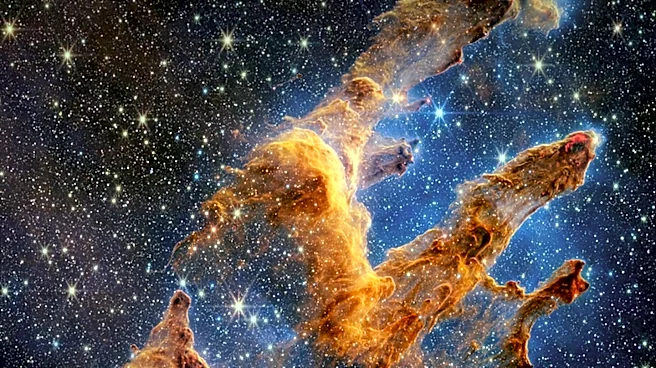
The Hubble Space Telescope has provided stunning views of the 'Pillars of Creation,' a region of interstellar gas and dust within the Eagle Nebula, located 6,500 light-years away in the Serpent's constellation. These prominent pillars are known as a site
where new stars are actively forming. While visible light images show the illuminated gas and dust, obscuring the internal processes, Hubble's infrared capabilities offer a dramatically different perspective. By utilizing the infrared channel on its Wide Field Camera 3, the telescope can peer through much of the dust that blocks visible light. This infrared view reveals the internal structure of the pillars, showing hot spots where protostars are coalescing and heating the surrounding dust cocoons. It also allows for the observation of many more stars across the field, which are otherwise hidden by dust in visible light, providing complementary information about star formation.
Why It's Important?
The Hubble Space Telescope's ability to capture both visible and infrared images of the 'Pillars of Creation' is crucial for a comprehensive understanding of star formation processes. Visible light images highlight the effects of already formed stars ionizing the background gas, while infrared imaging penetrates the dense dust to reveal the nascent stars themselves. This dual perspective allows astronomers to study different stages of stellar evolution within the same region, from the initial collapse of gas and dust to the emergence of protostars. Understanding these processes is fundamental to astrophysics, as it sheds light on how stars, and subsequently planetary systems, are born and evolve. The detailed observations provided by Hubble contribute significantly to our knowledge of the Milky Way galaxy's dynamics and the broader mechanisms governing the universe's structure and composition.
What's Next?
Continued observations of star-forming regions like the 'Pillars of Creation' with advanced telescopes, including the Hubble Space Telescope and upcoming instruments like the Nancy Grace Roman Space Telescope, will further refine our understanding of stellar nurseries. Future studies will likely involve combining data from multiple wavelengths, including infrared, to create even more detailed three-dimensional models of these complex environments. This will allow scientists to track the evolution of protostars more precisely, analyze the chemical composition of the dust and gas clouds, and investigate the influence of massive stars on their surroundings. The ongoing collection of such data will contribute to developing more accurate theoretical models of star formation, ultimately enhancing our comprehension of the cosmic cycle of birth, life, and death of stars.
Beyond the Headlines
The 'Pillars of Creation' imagery, made famous by the Hubble Space Telescope, transcends scientific utility to become a cultural icon, symbolizing the awe-inspiring beauty and dynamic nature of the cosmos. These images not only educate the public about star formation but also inspire a sense of wonder and curiosity about the universe. The ability of infrared technology to reveal hidden phenomena, such as stars forming within dense dust clouds, highlights the limitations of human perception and the power of scientific instrumentation to extend our senses. This continuous unveiling of cosmic secrets fosters a deeper connection between humanity and the universe, encouraging scientific literacy and supporting the ongoing pursuit of knowledge about our origins and the vastness beyond Earth. The ethical implications of such discoveries often lead to philosophical discussions about life, existence, and the universe's ultimate fate.