



What's Happening?
Astronomers have made a significant breakthrough in understanding star formation by capturing detailed images of the reflection nebula NGC 1333, located 1,000 light-years away in the constellation Perseus. This nebula, also known as the Embryo Nebula,
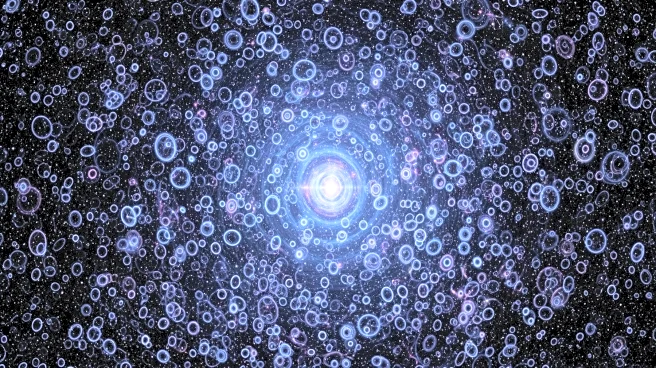
is a site of active star formation. The images, obtained using the Atacama Large Millimeter/submillimeter Array (ALMA) in Chile, reveal over 400 ultra-thin, bow-shaped molecular rings. These rings are the result of energetic outbursts from a young star in the binary system SVS 13. The discovery provides the first direct observational evidence supporting a theoretical model of how young stars accumulate and then explosively expel surrounding material. The youngest ring corresponds to a bright outburst observed in the early 1990s, linking a specific burst of activity to changes in the speed of the star's jet.
Why It's Important?
This discovery is crucial for advancing our understanding of star formation and the early stages of stellar evolution. By providing a 'time-stamp' of past eruptions, the rings offer insights into the growth of young stars and the shaping of their developing planetary systems. The ability to directly observe and confirm theoretical models enhances our knowledge of the processes that govern star formation, which is fundamental to understanding the evolution of galaxies and the universe. This research could also inform future studies on the formation of solar systems, potentially impacting our understanding of how planets, including those in our solar system, are formed.
What's Next?
The findings open new avenues for research into the dynamics of star formation. Future studies may focus on observing similar phenomena in other star-forming regions to determine if these processes are universal. Additionally, the data could be used to refine existing models of star formation and to explore the implications for the formation of planetary systems. Researchers may also investigate the potential for these findings to inform the search for exoplanets and the conditions necessary for life.
Beyond the Headlines
The discovery highlights the importance of advanced astronomical technology, such as ALMA, in uncovering the mysteries of the universe. It underscores the role of international collaboration in scientific research, as the data was collected using facilities in Chile and analyzed by a global team of astronomers. This research not only contributes to our understanding of the cosmos but also demonstrates the potential for future discoveries that could reshape our knowledge of the universe.