



What's Happening?
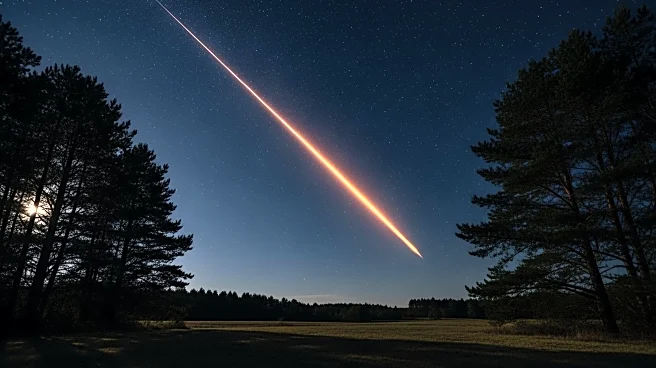
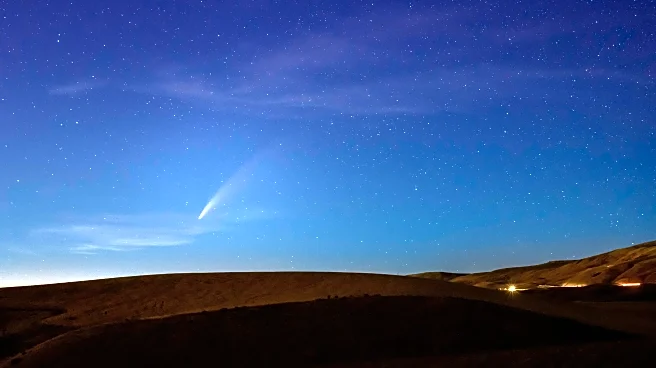
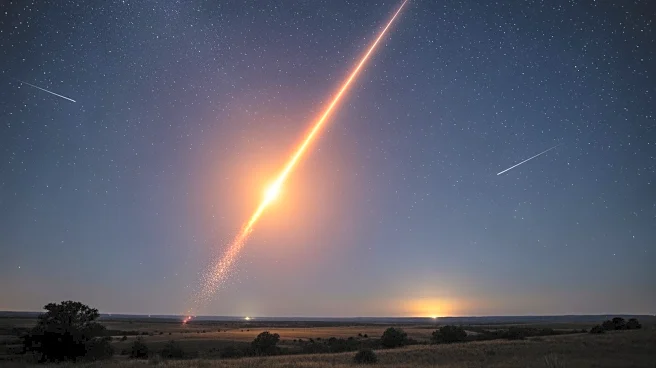
Residents across East Texas experienced a surprising meteor event on March 21, 2026, when a meteor streaked across the sky, accompanied by a loud boom. NASA confirmed that the fireball became visible about 49 miles above Stagecoach, northwest of Houston,
traveling southeast at approximately 35,000 mph. The meteor, estimated to be one ton in mass and three feet in diameter, disintegrated around 29 miles above Bammel, near Cypress Station. The breakup of the meteor created a pressure wave that produced audible booms. NASA reported that the resulting fireball released energy equivalent to 26 tons of TNT into the atmosphere. Doppler radar detected fragments of the meteorites between Willowbrook and Northgate Crossing, and a local woman reported that a meteorite crashed through her roof.
Why It's Important?
The meteor event in Texas highlights the ongoing need for monitoring and understanding near-Earth objects. Such events, while rare, can have significant implications for public safety and scientific research. The energy released by the meteor's explosion underscores the potential impact of larger meteors, which could pose a threat to populated areas. This incident also provides an opportunity for scientists to study meteorites and gain insights into the composition of celestial bodies. The public's interest in such events can drive support for space research and funding for programs aimed at tracking and mitigating potential asteroid threats.
What's Next?
Following the meteor event, NASA and other scientific organizations may conduct further investigations to locate and analyze meteorite fragments. These studies can enhance understanding of the meteor's origin and composition. Additionally, the event may prompt discussions on improving detection and response strategies for future meteor threats. Public interest in space phenomena could lead to increased educational outreach and engagement in astronomy and space science.