







What's Happening?
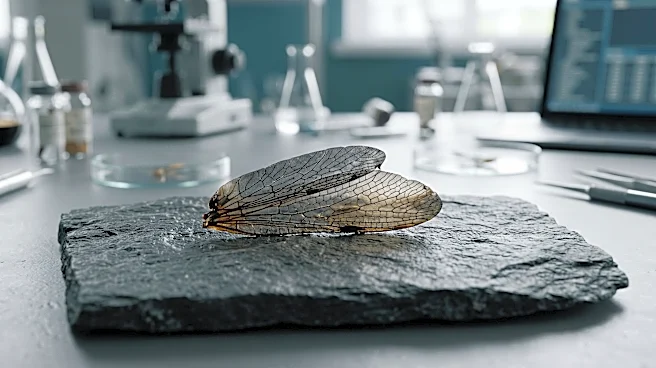
Scientists have successfully reconstructed the sounds of 165-million-year-old insects using fossilized wing fragments discovered in China. This groundbreaking research, led by Dr. Jun-Jie Gu of Sichuan Agricultural University, involved examining 20 fossilized ensiferan
insects from the Jiulongshan Formation in Inner Mongolia, dating back to the Middle Jurassic period. The team utilized a combination of techniques, including comparisons with nearly 100 living insect species, laser vibrometry on modern insect wings, computer simulations of fossil wing vibrations, and machine-learning models. These methods allowed them to decipher the acoustic signals embedded within the delicate wing structures, which these insects used for stridulation—rubbing one wing against another to 'sing.' The findings, published in the Proceedings of the National Academy of Sciences, reveal a surprisingly diverse ancient soundscape, including one species, Sigmaboilus peregrinus, that communicated in the ultrasonic range, beyond human hearing.
Why It's Important?
This discovery significantly alters long-held assumptions about the evolution of ultrasonic communication in animals. Previously, bats were largely credited with driving the development of ultrasound in insects as a defense mechanism against echolocating predators. However, bats emerged approximately 55 million years after these fossil insects, indicating that ultrasonic communication predates their appearance. This suggests that other factors, such as early mammals and non-mammalian ancestors, might have influenced the diversification of acoustic signaling strategies. The research also highlights the potential role of interspecific competition in driving the evolution of ultrasound through acoustic niche partitioning. Understanding these ancient soundscapes provides a unique window into the ecological dynamics of the Jurassic period and offers new insights into the co-evolutionary arms race between predators and prey.
What's Next?
The research team plans to continue exploring other fossilized insect remains to further expand the understanding of ancient acoustic environments. Future studies may focus on identifying more species that utilized ultrasonic communication and investigating the specific environmental pressures that led to these evolutionary adaptations. This could involve analyzing additional fossil sites and employing advanced imaging and computational techniques to reconstruct even more detailed sound profiles. The findings could also inspire new research into the sensory capabilities of other ancient creatures and how they interacted within their ecosystems. Further investigation into the role of early mammals in shaping insect communication could also be a key area of future study.
Beyond the Headlines
The ability to reconstruct sounds from such ancient fossils opens up new avenues for paleontological research, moving beyond visual and structural analysis to an auditory understanding of prehistoric life. This interdisciplinary approach, combining paleontology, bioacoustics, and machine learning, demonstrates the power of technological advancements in unraveling the mysteries of Earth's past. The revelation that a complex acoustic world existed long before previously thought challenges our anthropocentric view of sound and communication, emphasizing the rich and diverse sensory experiences of ancient ecosystems. It also underscores the resilience and adaptability of life forms, showcasing how evolutionary pressures can lead to sophisticated communication strategies over vast geological timescales.