




What's Happening?
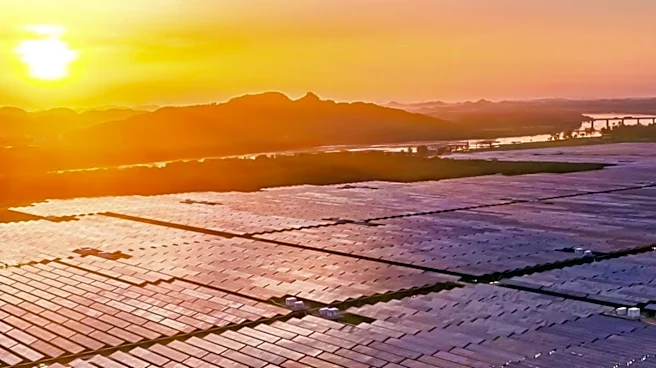
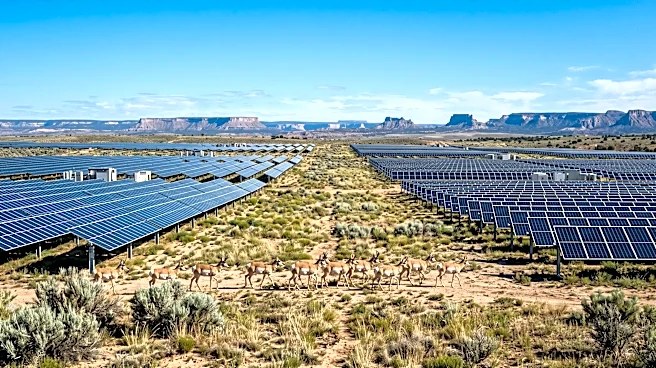
A 1,100-acre, 200-megawatt solar farm in northwestern New Mexico, the San Juan Solar and Storage Project, has shown unexpected results regarding wildlife interaction. Unlike a previous study in Wyoming where a single-fenced solar farm displaced pronghorn,
75 GPS-collared female pronghorn in New Mexico are navigating through the new facility. The San Juan project, built on the site of a retired coal plant, is divided into nine individually fenced arrays with open passages between them due to existing public roads, private land ownership, and natural arroyos. Researchers from Wildlands Network, supported by a $1.7 million Department of Energy grant, have been tracking the pronghorn since March 2024, collecting over a million GPS locations and millions of trail camera photos. The data indicates that pronghorn are using these passages, with 18 out of 30 collared females approaching within 328 feet of the fencing, suggesting no significant avoidance threshold.
Why It's Important?
This study offers critical insights into how large-scale solar energy development can coexist with wildlife, particularly in sensitive ecosystems. The findings challenge the assumption that utility-scale solar farms inevitably lead to habitat loss for species like pronghorn, which are known for their inability to jump fences. The design of the San Juan Solar project, with its intentional gaps, provides a potential model for future renewable energy infrastructure to minimize ecological impact. This is particularly important as the U.S. expands its solar capacity to meet energy demands and climate goals. Understanding how wildlife interacts with these facilities can inform better siting and design practices, potentially reducing conflicts between conservation efforts and renewable energy development. The economic implications include potentially lower costs for wildlife mitigation if effective design strategies can be integrated from the outset, avoiding expensive retrofits or legal challenges.
What's Next?
The research team is currently drafting a second paper, expected to be submitted later in 2026, which will specifically focus on identifying which passage sizes and shapes pronghorn are most likely to use. This will provide actionable data for developers and policymakers. The initial paper, based on the first 18 months of data, has been submitted for peer review to the journal Ecosphere. While the researchers caution against broad generalizations, the practical takeaway is that strategically placed gaps can facilitate wildlife movement. This could influence future permitting requirements for solar farms, with states potentially mandating similar corridor designs. The ongoing data collection will continue to refine understanding of pronghorn behavior within industrial landscapes, potentially leading to more harmonized land use planning for energy and conservation.
Beyond the Headlines
The study highlights a broader ethical and environmental challenge: balancing the urgent need for renewable energy with biodiversity conservation. While the pronghorn are navigating the solar farm, the researchers emphasize that the land remains altered habitat, and pronghorn numbers are still declining in New Mexico due to drought and other factors. This suggests that even with adaptive designs, large-scale human development inevitably impacts natural ecosystems. The findings underscore the importance of interdisciplinary approaches, combining ecological research with engineering and urban planning, to create more sustainable infrastructure. It also raises questions about the long-term behavioral adaptations of wildlife to human-modified landscapes and the potential for 'ecological traps' where animals are drawn into areas that ultimately reduce their fitness. The success of these passages, even if accidental, could set a precedent for integrating ecological considerations into industrial design from the ground up.