
What's Happening?
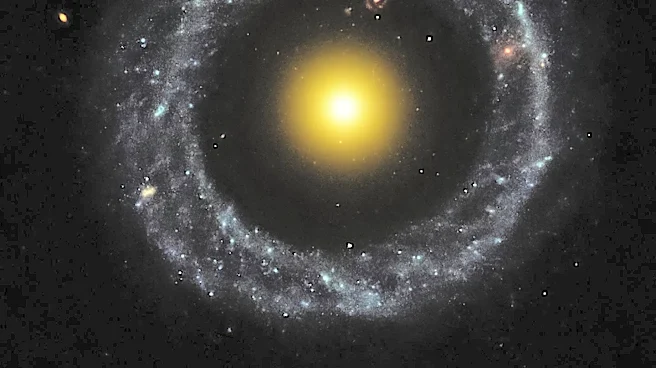
Astronomers have for the first time observed a dead star, specifically the Helix Nebula, being recycled back into the interstellar gas from which it originated. This observation, led by Yale University's Pieter van Dokkum, provides a complete picture
of a star's life cycle. Stars, after millions or billions of years, eventually exhaust their fuel. Sun-like stars, at their end, transform into planetary nebulae, like the Helix Nebula located 650 light-years away in the constellation of Aquarius. The Helix Nebula's central star ran out of hydrogen for nuclear fusion, causing its core to contract and its outer layers to expand into a red giant before detaching to form the nebula. The inert core became a white dwarf. As the nebula expands, its material disperses into the interstellar medium (ISM), enriching gas clouds that will eventually form new stars. This process, where stellar debris transitions into diffuse gas, has been challenging to observe until now. The discovery was made during the calibration of a new astronomical instrument called MOTHRA at the El Sauce Observatory in Chile.
Why It's Important?
This observation is crucial for understanding the cosmic cycle of matter and the origins of stars, planets, and potentially life. It confirms the long-held theory that elements formed within stars are returned to the galaxy, providing the building blocks for subsequent generations of celestial bodies. Our own solar system, including Earth, formed 4.6 billion years ago from elements produced by dead stars. The study provides direct evidence of this recycling process, which was previously theoretical. The ability to witness this 'hand-off' from stellar debris to diffuse gas significantly advances astronomical knowledge. It also offers a glimpse into the ultimate fate of our own Sun, which is expected to undergo a similar process in about five billion years, becoming a planetary nebula and returning its material to the Milky Way. This understanding helps scientists refine models of stellar evolution and galactic chemical enrichment.
What's Next?
The MOTHRA instrument, which facilitated this discovery, is still under development. Once fully operational with its 1,140 telephoto lenses, it will scrutinize the night sky for faint gas traces in the Milky Way galaxy. This will likely lead to further observations and a deeper understanding of interstellar medium dynamics and stellar life cycles. Researchers will continue to analyze the data from the Helix Nebula, particularly the 22 arc-shaped clumps of gas observed in its outer halo, to better understand how these structures erode and disperse into the ISM. The team estimates that material from a planetary nebula can survive for approximately 10,000 years after encountering the ISM before being completely absorbed. Future studies will likely focus on observing other planetary nebulae and their interaction with the ISM to confirm and expand upon these findings, providing more comprehensive insights into the universal process of stellar recycling.
Beyond the Headlines
The observation of the Helix Nebula's material returning to the galaxy carries profound implications beyond immediate astronomical understanding. It underscores the interconnectedness of cosmic phenomena and the cyclical nature of matter in the universe. The elements that constitute everything around us, including life on Earth, originated from previous generations of stars. This discovery reinforces the idea that the universe is constantly regenerating, with the remnants of old stars forming the raw material for new ones. It highlights the transient yet essential role of stars in the grand cosmic narrative, acting as cosmic furnaces that forge elements and then redistribute them. The eventual fate of our Sun, mirroring the Helix Nebula, serves as a powerful reminder of our place within this vast, dynamic, and ever-evolving cosmos, where even 'dead' stars contribute to future creation.