





What's Happening?
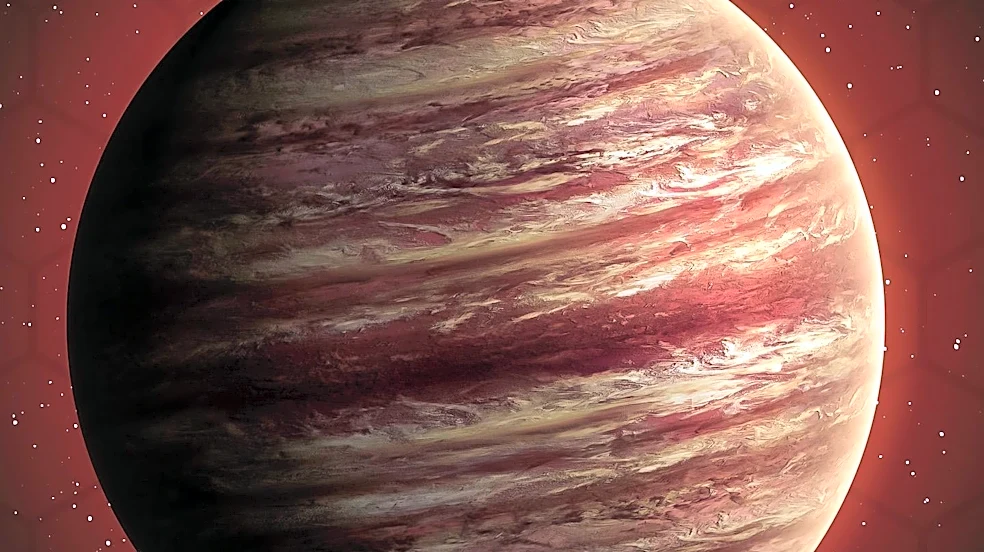
Astronomers have discovered a unique exoplanetary system, TOI-3686, featuring a hot Jupiter and a sub-Neptune locked in a 2:1 mean-motion resonance. The hot Jupiter, TOI-3686 c, has an orbital period of 5.078 days and exhibits significant transit timing
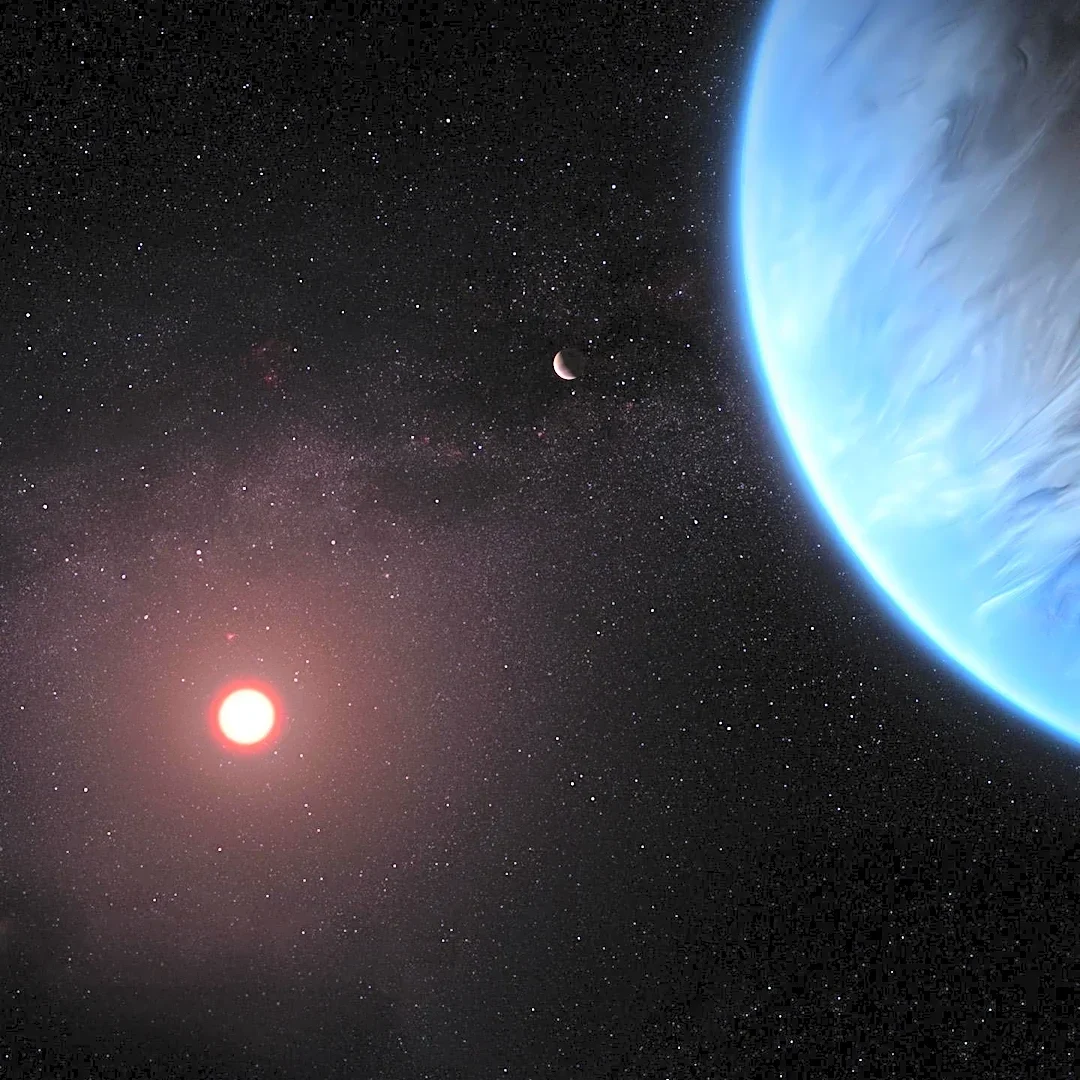
variations (TTVs) of up to 40 minutes, which are among the largest ever observed for a hot Jupiter. Subsequent analysis of TESS data revealed the presence of a second planet, TOI-3686 b, a sub-Neptune with an orbital period of 2.54 days, also showing substantial TTVs of up to 10 hours. The precise 2:1 orbital period ratio indicates that these two planets are in a resonant configuration, where for every two orbits of the inner sub-Neptune, the outer hot Jupiter completes one orbit. This discovery adds to the rare class of systems where hot Jupiters are found with nearby planetary companions, challenging the notion that hot Jupiters are typically 'lonely' planets.
Why It's Important?
The TOI-3686 system is crucial for understanding planetary system formation and evolution, particularly the dynamics of resonant configurations and the survival of multiple planets in close proximity to their host star. The significant TTVs observed in both planets provide valuable data for precisely determining their masses and orbital parameters, offering insights into their gravitational interactions. This system challenges existing theories that suggest hot Jupiters often clear out or prevent the formation of other planets in their vicinity. The presence of a sub-Neptune in a stable 2:1 resonance with a hot Jupiter indicates that such configurations can form and persist, potentially through specific migration pathways or in situ formation scenarios. Studying TOI-3686 can help refine models of planet migration, tidal interactions, and the long-term stability of multi-planet systems, contributing to a more complete picture of exoplanetary diversity and evolution.
What's Next?
Future research on the TOI-3686 system will likely involve more detailed photometric and spectroscopic observations to further characterize the planets and their host star. Precise radial velocity measurements will be critical to independently confirm the planetary masses derived from TTVs and to search for any additional, non-transiting planets in the system. Dynamical modeling will be employed to simulate the long-term stability of the 2:1 resonance and to explore potential formation pathways that could lead to such a configuration. Atmospheric characterization of both the hot Jupiter and the sub-Neptune, possibly using facilities like the James Webb Space Telescope, could provide insights into their compositions and atmospheric properties, offering clues about their formation environments. The system will also serve as a valuable case study for comparative planetology, helping to understand the conditions under which resonant multi-planet systems can form and survive.
Beyond the Headlines
The TOI-3686 system offers a fascinating glimpse into the intricate dance of planets in resonant orbits, a phenomenon that highlights the complex gravitational dynamics governing planetary systems. The discovery challenges the prevailing narrative of 'lonely' hot Jupiters, suggesting that our understanding of their formation and interaction with other planets is still evolving. This system underscores the incredible diversity of exoplanetary architectures and the need for flexible theoretical models to account for such unique configurations. The existence of stable resonances like the 2:1 in TOI-3686 provides a natural laboratory for testing gravitational theories and understanding how planetary systems maintain their order amidst chaotic forces. It also sparks curiosity about the potential for life in such dynamically active systems, although the extreme temperatures of hot Jupiters typically preclude habitability. Ultimately, TOI-3686 enriches our cosmic catalog with another extraordinary example of planetary ingenuity.