





What's Happening?
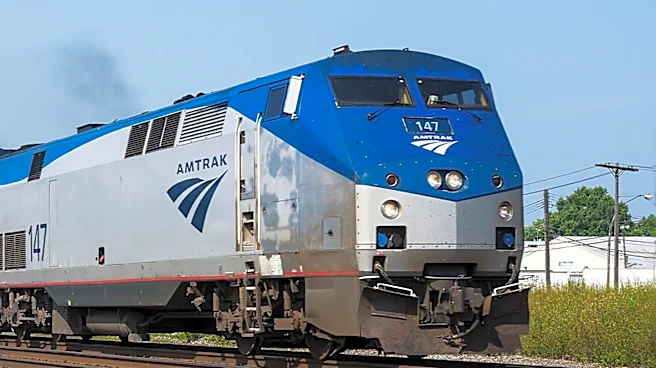
Residents of Bridgeport, Chicago, are voicing strong opposition to Amtrak's plan to relocate its maintenance facility from the South Loop to their neighborhood. The $900 million project, set to begin construction next year and be completed by 2028, involves
building an eight-track rail yard and a four-story maintenance building along South Canal Street, adjacent to the Chicago White Sox's Rate Field. Amtrak secured nearly $600 million in grant funding from the Federal Railroad Administration for the move, with an additional $125 million contributed by businessman Justin Ishbia through his LLC, Canal Edge. The relocation aims to modernize Amtrak's operations, which currently suffer from an undersized and poorly maintained facility in the South Loop. However, residents at a community meeting raised concerns about potential pollution, noise, environmental impact, traffic, and safety issues. They also fear that the move could facilitate the White Sox's departure from Bridgeport, a possibility that Alderman Nicole Lee (11th) has publicly committed to preventing, despite acknowledging residents' concerns about the project's impact.
Why It's Important?
This development holds significant importance for several reasons, impacting urban planning, community welfare, and the future of a major sports franchise. For Bridgeport residents, the proposed Amtrak facility represents a substantial industrial intrusion into a residential area, raising serious concerns about quality of life, health, and environmental degradation. The project's categorical exclusion from federal environmental regulations further exacerbates these fears, suggesting a potential bypass of thorough impact assessments. Economically, while Amtrak touts the creation of 3,000 union jobs during construction, the long-term economic and social costs to the existing community, particularly if property values or local businesses are negatively affected, remain a concern. Furthermore, the potential relocation of the Chicago White Sox, a team with a 126-year history in Bridgeport, would have a profound cultural and economic impact on the neighborhood, potentially leading to a loss of identity and revenue for local businesses. The situation highlights the tension between large-scale infrastructure development and local community interests, with residents feeling their voices are being marginalized in decisions that directly affect their homes and futures.
What's Next?
A follow-up community meeting regarding Amtrak's rail yard project is scheduled for August 26 at the Pui Tak Center. This meeting will likely provide another platform for residents to express their concerns and seek further clarification from Amtrak officials. Alderman Nicole Lee (11th) has stated her commitment to keeping the White Sox in Bridgeport, indicating that local political efforts will continue to oppose any relocation of the team. The involvement of businessman Justin Ishbia, who has an option to buy a majority stake in the White Sox in 2029 and is also financing part of the Amtrak relocation, suggests a complex interplay of interests that will continue to unfold. The outcome of these community discussions and political interventions will determine the future of the Amtrak facility and potentially the White Sox's presence in Bridgeport. Residents are expected to continue their protests and advocacy against the project, particularly given the environmental concerns and the perceived lack of consideration for their community's well-being.
Beyond the Headlines
The controversy surrounding Amtrak's rail yard relocation in Bridgeport extends beyond immediate environmental and economic concerns, touching upon deeper issues of urban development, community empowerment, and the balance of power between large corporations and local residents. The categorical exclusion from federal environmental regulations raises questions about the transparency and accountability of such large-scale infrastructure projects, particularly when they impact established communities. This situation could set a precedent for how similar developments are handled in other urban areas, potentially influencing future environmental review processes and community engagement strategies. The potential departure of the White Sox also highlights the broader trend of sports franchises seeking new, often publicly funded, stadiums, and the subsequent impact on their traditional fan bases and surrounding neighborhoods. This event underscores the ethical dilemma of prioritizing corporate and infrastructural efficiency over the preservation of community character and resident well-being, prompting a re-evaluation of how urban planning decisions are made and whose interests are ultimately served.