







What's Happening?
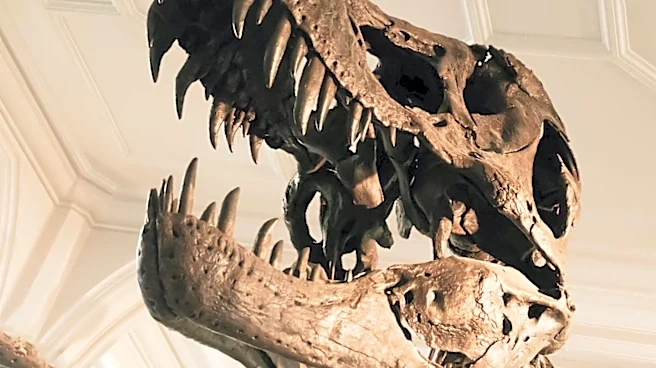
A new study from Yale University, published in the journal Current Biology, indicates that the giant prehistoric dinosaur Spinosaurus was highly aquatic and spent the vast majority of its time submerged in water. This research challenges previous interpretations
that suggested a more heron-like lifestyle, with the Spinosaurus primarily hunting along shorelines. Lead author Caleb Gordon, a postdoctoral researcher at the Florida Museum of Natural History, and senior author Bhart-Anjan Bhullar, an associate professor at Yale, utilized a combination of traditional paleontological techniques, machine learning models, and a statistical approach originally developed during World War II to analyze hundreds of fossil and modern specimens. Their methodology allowed them to reconstruct the lifestyles of extinct animals by identifying relationships between skeletal proportions and known aquatic behaviors, even predicting soft tissue adaptations that do not preserve in fossils. The study also examined mesosaurs, small marine reptiles, concluding that they regularly moved between aquatic and terrestrial environments, unlike Spinosaurus.
Why It's Important?
This research significantly advances the understanding of evolutionary transitions from land to water and the behavior of extinct species. By employing machine learning and a novel statistical method, the study provides a more objective and rigorous way to interpret fossil evidence, reducing subjectivity in paleontological reconstructions. The findings offer new insights into convergent evolution, where different species adapt similarly to comparable environmental pressures, such as developing flippers for aquatic life. This improved methodology can be applied to other major evolutionary changes, potentially shedding light on how human ancestors developed bipedalism or how bird ancestors evolved flight. For the scientific community, it establishes a new standard for analyzing incomplete fossil records and resolving long-standing debates about ancient animal behaviors, thereby enhancing the accuracy of our understanding of Earth's biological history.
What's Next?
The methodology developed in this study, which combines machine learning with historical statistical techniques, is poised to be applied to a broader range of evolutionary mysteries. Researchers may use this approach to investigate other significant transitions in the history of life, such as the evolution of flight in birds or the development of bipedalism in human ancestors. The findings regarding Spinosaurus are likely to stimulate further research into its hunting strategies and ecological role within its aquatic environment. Additionally, the study's conclusions about mesosaurs, suggesting they were not fully aquatic, could prompt re-evaluations of other Paleozoic marine reptiles to determine the extent of their aquatic adaptations. This new framework offers a promising avenue for paleontologists to make more confident predictions about the lifestyles of extinct species, even when direct evidence is scarce or contradictory.
Beyond the Headlines
The study's innovative use of a statistical technique from World War II, originally designed to identify enemy planes, highlights the interdisciplinary nature of scientific discovery and the potential for repurposing tools from disparate fields. This approach underscores a broader shift in paleontology towards integrating advanced computational methods with traditional fossil analysis, moving beyond subjective interpretations. The ability to predict soft tissue adaptations from skeletal remains, which rarely fossilize, represents a significant leap in reconstructing the complete picture of extinct life forms. This not only enriches our understanding of ancient ecosystems but also raises ethical considerations about the extent to which technology can infer biological realities from limited physical evidence. The research also subtly emphasizes the continuous, dynamic nature of evolution, where species can reverse evolutionary paths, returning to environments their distant ancestors left, showcasing the adaptability of life over millions of years.