



What's Happening?
Forester Amelia Napper, associated with the Ruffed Grouse Society and American Woodcock Society (RGS & AWS), is challenging the conventional belief that forests are best left untouched. Through her work, Napper advocates for active stewardship, including
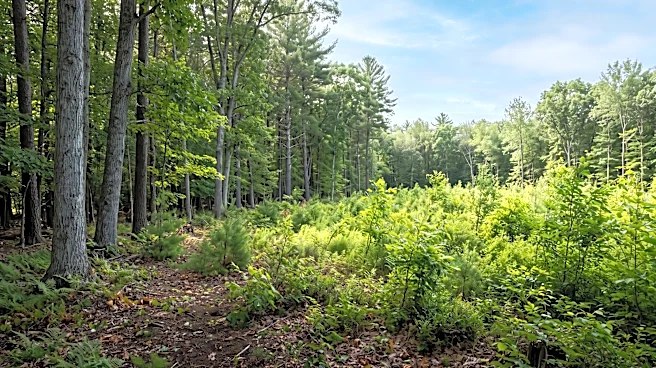
canopy openings, young forest creation, and carefully planned treatments, as essential for maintaining healthy wildlife habitats and resilient forests. This approach is highlighted in a new Land Ethic in Action story by the Aldo Leopold Foundation. Napper's efforts aim to educate landowners and community members on the necessity of intervention, particularly given the decline in habitat for species like ruffed grouse and American woodcock due to historical fire suppression and reduced timber harvests. RGS & AWS partners with agencies and landowners on targeted forest management, including timber sales for the U.S. Forest Service, with surplus funds reinvested into habitat work such as prescribed fire, invasive plant removal, and road-stream crossing improvements. Karl Malcolm, vice president of conservation for RGS & AWS, emphasizes that active management helps restore the diversity that once developed naturally in forests, which were historically shaped by animals, people, and disturbances.
Why It's Important?
This advocacy for active forest management is crucial for addressing the ongoing decline of specific wildlife populations and the overall health of forest ecosystems across the U.S. The traditional 'hands-off' conservation approach, while well-intentioned, has inadvertently led to an imbalance in forest structures, reducing the young forest conditions necessary for many species. By promoting practices like prescribed fire and mechanical treatments, Napper and RGS & AWS are working to mimic natural processes that have been suppressed, thereby creating diverse habitats and increasing forest resilience against threats like disease and wildfire. This shift in perspective is vital for public policy, as it encourages a more proactive and science-based approach to land management. It also highlights the economic aspect of forest health, as timber sales can generate funds that are then reinvested into further conservation efforts, creating a sustainable cycle. The long-term impact could be a revitalization of forest biodiversity and a reduction in catastrophic events like wildfires, which are often exacerbated by overgrown and unhealthy forests.
What's Next?
The Ruffed Grouse Society and American Woodcock Society will continue their efforts to build support for active forest management among members, agencies, and the public. This involves ongoing outreach and education, often conducted directly in the forest, to help people understand the ecological benefits of interventions. Forester Amelia Napper will likely continue her work with landowners and communities, fostering conversations and demonstrating the practical application of active stewardship. The organization will also persist in partnering with the U.S. Forest Service and other agencies on targeted management projects, reinvesting funds from timber sales into habitat improvements. The goal is to expand the adoption of practices such as prescribed fire and mechanical treatments to create and maintain diverse forest ecosystems. The success of these initiatives will depend on continued collaboration between conservation groups, government agencies, and private landowners, as well as a broader public acceptance of active management as a necessary component of forest health.
Beyond the Headlines
The debate over active versus passive forest management touches upon deeper philosophical questions about humanity's role in nature. The 'hands-off' approach often stems from a romanticized view of wilderness, where human intervention is seen as inherently detrimental. However, as Napper and Malcolm point out, many North American forests were historically shaped by indigenous practices, animal activity, and natural disturbances like fire. The current advocacy for active management represents a re-evaluation of this relationship, suggesting that responsible human intervention can be a form of stewardship, essential for restoring and maintaining ecological balance. This perspective challenges the notion of a pristine, untouched wilderness and instead promotes a dynamic, co-evolutionary relationship between humans and natural systems. The long-term implications could include a more integrated approach to conservation, where ecological science, traditional knowledge, and community engagement work together to create resilient landscapes that benefit both wildlife and human well-being. It also raises ethical questions about our responsibility to manage ecosystems that have been altered by past human actions, such as fire suppression.