





What's Happening?
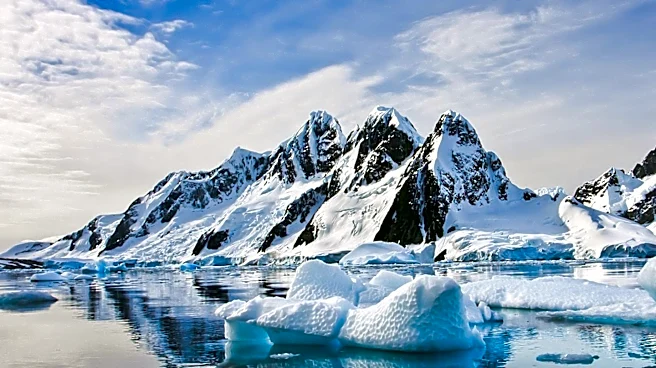
A new study published in the journal Earth and Planetary Science Letters proposes that the erosion of vast, Himalayan-scale mountains in ancient Antarctica, formed during the assembly of the supercontinent Gondwana between 650 million and 450 million years
ago, played a crucial role in the Cambrian explosion. Researchers, including Bei Chen and Ian Campbell of the Australian National University, analyzed detrital zircon crystals washed off Antarctica to reconstruct this vanished landscape. They found a striking signal of zircons dating from 650 million to 450 million years ago, with a significant portion originating from Antarctica and southeastern Australia during the 540 million to 510 million year interval. These zircons, particularly those depleted in lutetium, indicate formation under the intense pressures found beneath very high mountains. The study suggests that these mountain ranges, which extended for roughly 20,000 kilometers, contributed to fertilizing the oceans and burying carbon-rich sediment, thereby creating conditions conducive to the rapid diversification of animal life around 530 million years ago.
Why It's Important?
This research offers a significant new perspective on the environmental factors that may have triggered the Cambrian explosion, a pivotal event in Earth's history where a wide variety of animals rapidly appeared. By linking the geological processes of supercontinent formation and mountain erosion to oceanic fertilization and carbon burial, the study provides a plausible mechanism for increased oxygen levels in the oceans and atmosphere. This increased oxygen would have been vital for the evolution and proliferation of complex multicellular life. Understanding the interplay between tectonic activity, nutrient cycles, and atmospheric composition during this period is crucial for comprehending the trajectory of life on Earth. The findings challenge previous assumptions and highlight the profound impact of geological events on biological evolution, suggesting that the Earth's physical landscape was not merely a backdrop but an active participant in shaping life's diversity.
What's Next?
Future research will likely focus on further refining the estimates of ancient oxygen levels and the precise timing and extent of carbon and sulfur burial during the Gondwanan mountain-building period. The study acknowledges that its oxygen estimate is highly uncertain, serving primarily to demonstrate the plausibility of the proposed mechanism. Scientists may also investigate the interaction between this proposed mechanism and other theories regarding the Cambrian explosion, such as the role of volcanic activity and greenhouse gas release, as suggested by a separate Science Advances study. The ongoing effort to connect Gondwana's assembly with biological changes around the Ediacaran-Cambrian transition will continue, with researchers seeking to integrate various geological and biological datasets to build a more comprehensive picture of this critical evolutionary period. Further analysis of ancient rock records and isotopic data will be essential to corroborate and expand upon these findings.
Beyond the Headlines
The study's implications extend beyond the immediate understanding of the Cambrian explosion, touching upon the broader concept of Earth system science. It underscores the intricate and often delayed connections between geological processes and biological evolution. The idea that massive mountain ranges, long since eroded, could have left such a profound and lasting impact on the planet's biosphere highlights the deep-time perspective necessary for understanding Earth's history. This research also implicitly raises questions about the long-term effects of current geological and environmental changes. While the scale and context are vastly different, the principle that large-scale geological events can dramatically alter atmospheric and oceanic conditions, thereby influencing life, remains relevant. It encourages a holistic view of Earth as a dynamic, interconnected system where physical and biological components constantly interact and co-evolve over millions of years.