



What's Happening?
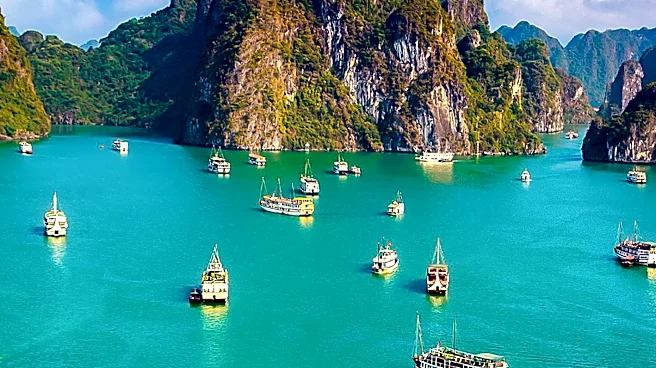
Vietnam is actively developing its 'blue economy,' aiming for significant growth in sectors like offshore wind energy and seafood exports. The country has set ambitious targets, including 6–10 gigawatts of offshore wind capacity by 2030 and achieving
a record US$11.3 billion in seafood exports in 2025. However, the Lowy Institute highlights that the success of this initiative hinges on more than just physical infrastructure like ports, vessels, and turbines. Vietnam faces institutional challenges, including overlapping responsibilities in marine governance, weak inter-sectoral and inter-regional coordination, and insufficient marine science and human resources. The government has recognized these issues, with Resolution 20 calling for marine spatial planning as a binding tool and an action plan initiated to revise the Law on Marine and Island Resources and Environment by 2026. This revision will address critical questions regarding marine space allocation, user fees, and conflict resolution.
Why It's Important?
The development of Vietnam's blue economy has significant implications for regional economic stability and environmental sustainability. The Lowy Institute emphasizes that effective marine governance is crucial to manage competing claims on marine space from various industries such as aquaculture, tourism, shipping, and conservation. Without a comprehensive approach, the rapid expansion of these sectors could lead to environmental degradation, resource depletion, and social conflicts. For the United States, Vietnam's success in balancing economic growth with sustainable marine management could serve as a model or a cautionary tale for other developing nations in the Indo-Pacific region, an area of strategic importance. Furthermore, the call for international cooperation, particularly with Australia, in marine science, education, and policy development, underscores the interconnectedness of global environmental and economic challenges. The ability of Vietnam to build robust institutions and human capital will determine its long-term success and its role as a growing middle-income economy seeking high-income status by 2045.
What's Next?
Vietnam is moving forward with an action plan to revise its Law on Marine and Island Resources and Environment, with an amended law expected to be submitted to the National Assembly in 2026. This legislative reform will be critical in establishing a clearer framework for marine spatial planning and inter-agency coordination. The country will also need to invest significantly in human resources, developing expertise in marine science, environmental management, economics, and public policy to effectively manage its blue economy. International partnerships, such as the enhanced Comprehensive Strategic Partnership with Australia, will play a vital role in knowledge transfer, joint research, and professional development. The implementation of these reforms and collaborations will determine Vietnam's ability to manage competing interests, protect marine natural capital, and translate new opportunities into broadly shared prosperity.
Beyond the Headlines
The challenges faced by Vietnam in developing its blue economy reflect a broader global dilemma: how to achieve economic growth while simultaneously protecting vital marine ecosystems. This situation highlights the complex interplay between economic ambition, environmental stewardship, and institutional capacity. The emphasis on 'institutional infrastructure'—encompassing knowledge, people, and governance—rather than solely physical assets, points to a paradigm shift in sustainable development. It underscores the idea that true progress requires robust regulatory frameworks, skilled workforces, and effective coordination among diverse stakeholders. The ethical dimension lies in ensuring that the benefits of the blue economy are equitably distributed among coastal communities and that environmental costs are not disproportionately borne by vulnerable populations or future generations. This case study offers valuable insights into the intricate process of building a sustainable marine economy in a rapidly developing nation, with lessons applicable to other countries facing similar pressures.