
What's Happening?
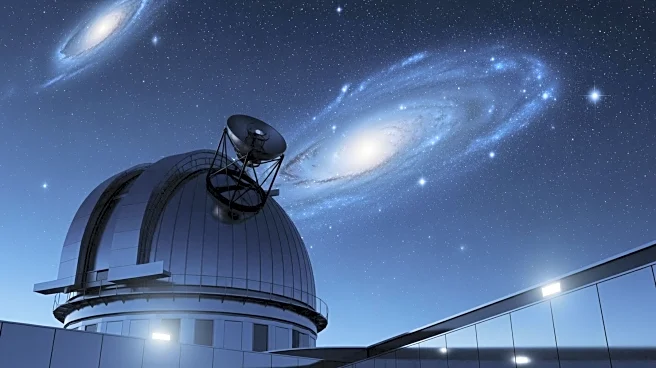
Tony Tyson, a physicist at the University of California, Davis, has been instrumental in the development of the Vera Rubin Observatory in Chile. This project, which Tyson first envisioned over 30 years
ago, is set to revolutionize our understanding of the universe. The observatory, equipped with the world's largest digital camera, will map the universe's dark matter in 3D, detect millions of stars, and identify potentially hazardous asteroids. Tyson's journey began with his work on charge-coupled device (CCD) sensors, which he realized could transform astronomy by detecting faint light from distant galaxies. Despite initial skepticism, Tyson's persistence led to the use of weak gravitational lensing to reveal dark matter, a technique he pioneered in 2000. The observatory's compact design allows it to capture different exposures every 40 seconds, making it a high-risk, high-reward project with an $810 million investment.
Why It's Important?
The Vera Rubin Observatory represents a significant advancement in astronomical research, with the potential to provide unprecedented insights into the universe's structure and composition. By mapping dark matter and detecting celestial phenomena, the observatory could enhance our understanding of cosmic evolution and the forces shaping the universe. This project underscores the importance of investing in scientific innovation and the potential for groundbreaking discoveries. The observatory's findings could influence future research directions and inspire new technologies, benefiting the scientific community and society at large. Tyson's work exemplifies the impact of visionary thinking and perseverance in overcoming challenges to achieve scientific breakthroughs.
What's Next?
As the Vera Rubin Observatory begins its operations, the scientific community eagerly anticipates the data it will generate. Researchers worldwide will analyze the observatory's findings to explore new theories and refine existing models of the universe. The observatory's success could lead to further investments in similar projects, expanding our capacity to study the cosmos. Additionally, the observatory's ability to detect asteroids may enhance planetary defense strategies, contributing to global safety. The project's outcomes could also influence educational programs, inspiring future generations of scientists and engineers.
Beyond the Headlines
The development of the Vera Rubin Observatory highlights the intersection of technology and science, showcasing how advancements in one field can drive progress in another. The observatory's use of CCD sensors, initially developed for other purposes, illustrates the potential for cross-disciplinary innovation. This project also raises ethical considerations regarding the allocation of resources for scientific research and the balance between high-risk investments and potential rewards. As the observatory's findings emerge, they may challenge existing paradigms and prompt philosophical discussions about humanity's place in the universe.