





What's Happening?
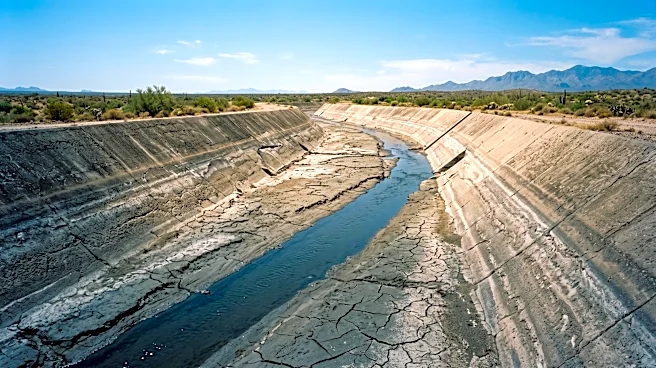
The Central Arizona Project (CAP) has filed a motion to intervene in a lawsuit that challenges the federal government's proposed plan for managing the Colorado River after 2026. CAP argues that the federal framework could severely reduce critical water
supplies to cities and tribal communities across Arizona. Brenda Berman, CAP's general manager, stated that while CAP has historically aimed to avoid litigation, legal action is now deemed necessary to protect Arizona's water rights. The lawsuit, initially filed by Nevada, contests the U.S. Bureau of Reclamation's two-year framework, which mandates lower basin states—Arizona, Nevada, and California—to cut 1.25 million acre-feet of water. CAP contends that the federal government cannot cut its supplies based on its junior water priority while the upper basin states (Colorado, New Mexico, Utah, and Wyoming) fail to meet their water-delivery obligations. Arizona's Department of Water Resources Director Tom Buschatzke has also warned that the proposed cuts could effectively dry up the Central Arizona Project, emphasizing that Arizona has agreed to a 30% reduction in Colorado River water for the next two years but does not want this to set a precedent for future cuts.
Why It's Important?
This legal action is critically important for Arizona's water security and economic stability. The Colorado River is a vital water source for millions of people, agriculture, and industries in the southwestern U.S. If CAP's water supplies are significantly cut, it could have devastating consequences for urban populations, tribal communities, and agricultural sectors in Arizona, potentially leading to water rationing, increased costs, and economic disruption. The dispute highlights the long-standing tensions and complex legal frameworks governing water allocation in the Colorado River Basin. The outcome of this lawsuit could redefine water rights and management policies for decades, impacting regional development, environmental conservation, and interstate relations. It also underscores the broader challenge of managing scarce resources in the face of climate change and increasing demand, setting a precedent for how water disputes are resolved in other arid regions.
What's Next?
The court has not yet ruled on the claims made by Nevada or CAP. The immediate next step will be for the court to decide on CAP's motion to intervene in the existing lawsuit. If granted, CAP will become a formal party, allowing it to present its arguments and evidence against the federal government's plan. The legal proceedings will likely involve extensive arguments regarding the interpretation of the Colorado River Compact, other relevant laws, and the National Environmental Policy Act. Stakeholders, including federal agencies, state governments, tribal communities, and environmental groups, will closely monitor the case. The outcome could lead to a revised federal management plan for the Colorado River, potentially altering water allocations and conservation strategies for the entire basin. This legal battle is expected to be protracted, with significant implications for water policy and resource management in the American Southwest.
Beyond the Headlines
This lawsuit delves into the deeper implications of water scarcity and the historical allocation of resources in the American West. The concept of 'junior water rights' and the complex web of agreements like the Colorado River Compact, dating back to 1922, reveal how past decisions continue to shape present-day challenges. The dispute highlights the inherent conflict between historical water claims and contemporary environmental realities, particularly the impact of climate change on river flows. It also brings to the forefront the disproportionate impact on tribal communities, who often hold senior water rights but have historically been marginalized in water management decisions. The legal battle is not just about water volume but also about sovereignty, economic justice, and the long-term sustainability of an entire region. The resolution of this case could force a re-evaluation of how water is valued, managed, and shared, potentially leading to more equitable and sustainable practices for future generations.