




What's Happening?
The Harvard Law Review has published an essay titled 'Fact Avoidance' by Shalev Gad Roisman, which analyzes a judicial tendency to resolve cases involving presidential power solely on interpretive grounds, thereby sidestepping a review of the factual
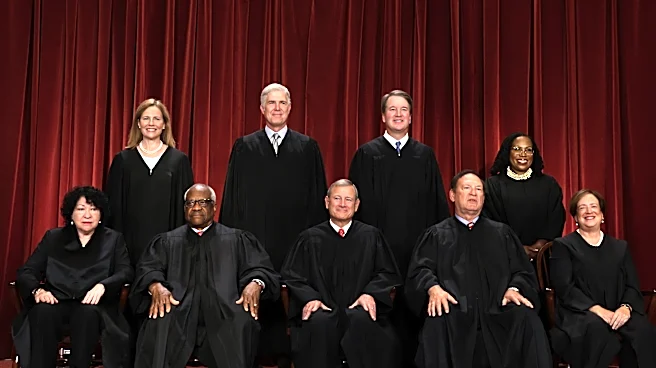
predicates underlying the President's actions. The essay highlights two recent Supreme Court cases, *Learning Resources, Inc. v. Trump* and *Trump v. Illinois*, as examples. In *Learning Resources*, President Trump invoked the International Emergency Economic Powers Act (IEEPA) to impose tariffs, claiming an 'unusual and extraordinary threat.' In *Trump v. Illinois*, President Trump sought to deploy the National Guard, asserting an inability to 'execute the laws' with regular forces. In both instances, the Supreme Court focused on whether President Trump's interpretation of the statutes was correct, rather than evaluating whether the factual conditions required to trigger the delegated power were actually met. For example, in *Trump v. Illinois*, a district court found that the factual conditions for deployment 'simply did not exist,' yet the Supreme Court's majority opinion explicitly stated it would not address the reviewability of President Trump's factual findings.
Why It's Important?
The phenomenon of 'fact avoidance' in judicial review of presidential power has significant implications for the balance of power within the U.S. government and the rule of law. By focusing exclusively on legal interpretation and avoiding scrutiny of the factual basis for presidential actions, courts may inadvertently grant the Executive Branch broader, less constrained authority. This approach can allow presidents to exercise delegated powers without robust checks on whether the underlying conditions for such exercise are genuinely present. The essay argues that this judicial choice, while seemingly modest, can lead to its own form of aggressive judicial action by distorting both the understanding of statutory authorization and the importance of factual accuracy. It raises questions about accountability and transparency in presidential decision-making, potentially eroding public trust in the legal system's ability to hold the Executive accountable for its claims, particularly in times of perceived emergency or crisis.
What's Next?
The essay suggests that courts need to reconsider their reluctance to review the factual predicates of presidential actions. While it does not advocate for *de novo* factual review in every instance, it argues that some level of factual scrutiny is often justified. This could lead to a re-evaluation of judicial review standards in cases involving executive power, potentially requiring courts to develop methods for assessing the factual claims made by the President. Such a shift would likely face challenges, as factual review can be complex and politically sensitive. However, if adopted, it could lead to more rigorous oversight of presidential authority, ensuring that the exercise of delegated powers is not only legally interpreted correctly but also grounded in verifiable facts. This could influence future legal challenges to executive orders and actions, particularly those taken under emergency powers, by compelling the Executive Branch to provide a more robust factual justification for its decisions.
Beyond the Headlines
The concept of 'fact avoidance' delves into the fundamental tension between legal interpretation and factual reality in the application of law. It highlights how the judiciary's choices in reviewing executive actions can shape the practical limits of presidential power. The essay implies that a system of review that neglects factual inquiry risks becoming detached from the real-world conditions that statutes are designed to address. This has broader implications for democratic governance, as it touches upon the extent to which the Executive can operate based on its own factual determinations without independent verification. The debate over 'fact avoidance' underscores the ongoing evolution of constitutional law and administrative law in the U.S., particularly concerning the scope of presidential authority in an increasingly complex and often crisis-driven political landscape. It challenges the legal community to consider how courts can effectively ensure that power is exercised responsibly and within its intended bounds, both legally and factually.